

Timeline is often the second question business owners ask next to the cost. An honest answer would be that the timeline would largely depend on what the team is working to build: a simple internal tool should be completed and deployed, while a full enterprise-level platform could easily take 12+ months. Miscalculating the schedule estimate would be a major problem since every item downstream it would also take the lead on the slippage of budget hiring plans, launch dates, and probably stakeholder confidence in the project itself. Knowing the custom software development timeline and process in advance can mean the difference between a project that ships on time and one that drags on for months more than planned. This article dissects a custom software development timeline by the size of the project, outlines what is it that actually makes the project move forward, and replies to the question most business owners will start from: how long does it take custom software to be built!
What Determines the Custom Software Development Timeline?
No two projects move at the same speed, even if they sound similar on paper. Timelines shift based on requirement clarity, feature complexity, team experience, and how many outside systems it must connect with. A basic CRM with three user roles will always move faster than a platform syncing with accounting software, inventory, and a payment gateway at the same time. This is why bringing in an experienced software development services partner during planning saves so much time later.
Typical Stages of Custom Software Development
Regardless of size, most custom software projects move through the same core stages, each taking up a fairly consistent share of the total timeline:
- Discovery & requirement gathering
This is where you nail down exactly what the software needs to do , through workshops, user stories, and technical scoping , and walk away with a signed-off requirements document. It usually takes 1 to 3 weeks and lands around 10% of the total timeline, but rushing it is what causes delays everywhere else later on.
- UI/UX design
Wireframes, clickable prototypes, and user-flow diagrams follow next, with decisions about the system architecture and the technology stack. It is typical for this phase, where no code has even been started yet, to last from 2 to 4 weeks or about 15% of the whole schedule.
- Development
Without a doubt, this one is the main deal. Coding for the frontend backend database, and all the interconnections takes up about 50 – 60% of the entire development timeline. And, a majority of this work is split into 2-week long Agile sprints. And after each sprint, a demo is held so that the product team and stakeholders can see what has been developed up until that point.
- Testing & QA
All major bug-checking happens in this phase: unit tests, integration tests, security verification as well as performance testing all serve to identify issues early before the users do so. This phase is estimated to cover roughly 15 or 20% of the timeline given various factors. But, if you’re one of those that make a heavy use of automated test suites, you’ll most likely go through this phase at a quicker pace.
- Deployment
Once everything checks out, going live means configuring servers, migrating from staging to production, and monitoring closely right after launch. This step is quick, usually just 1 to 2 weeks.
- Post-launch support
The work doesn’t stop at launch. Bug fixes, security patches, performance tuning, and new features continue on an ongoing basis, and most teams budget around 15 to 20% of the first year’s cost for this.
Each stage stretches out as the project gets bigger and more complex, which is exactly what shapes the numbers below.
How Long Does It Take to Build Custom Software by Project Size?
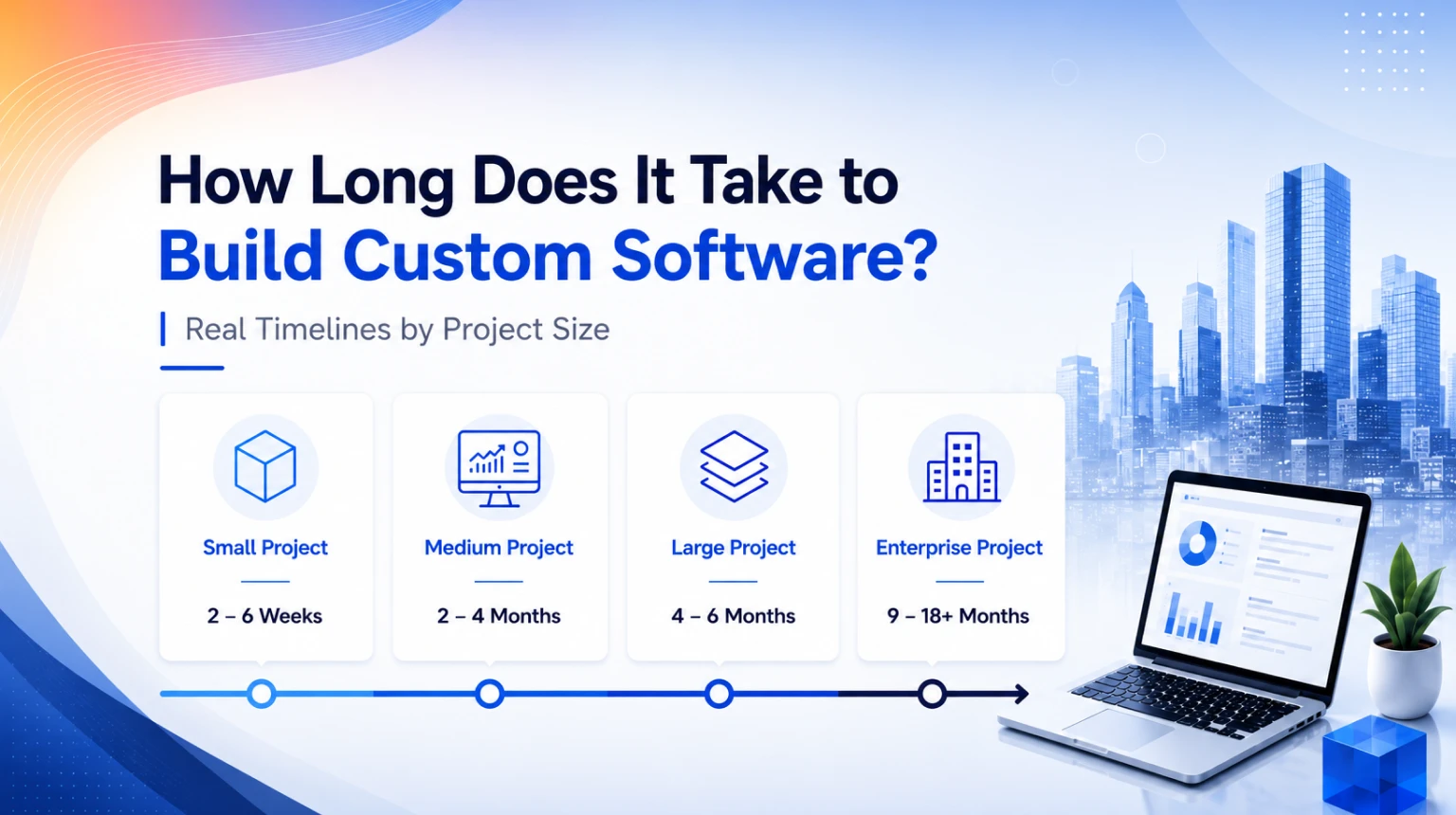
| Project Size | Typical Examples | Typical Timeline |
| Small | MVPs, internal tools, basic mobile apps, landing pages | 2–4 months |
| Medium | CRMs, e-commerce platforms, SaaS products, business apps with integrations | 4–8 months |
| Large Enterprise | ERP systems, banking or healthcare platforms, multi-module systems | 9–18+ months |
Small projects center on a single core function , an MVP or an internal tool for one team , and typically ship in 2 to 4 months. Medium projects add custom interfaces, multiple user roles, and integrations like payment gateways or APIs, generally taking 4 to 8 months. Enterprise builds must handle scale, security, and compliance across several connected systems, usually running 9 to 18 months or more, with regulated industries like healthcare and banking landing at the higher end.
Factors That Affect Software Development Timelines
Beyond raw project size, a handful of things consistently push timelines up or down:
- Requirement clarity – Requirements are the top cause of the 50–100% timeline and budget overruns common across the industry; a proper discovery phase largely offsets this risk
- Feature complexity – Real-time features like chat or live updates typically add 3–4 weeks, and AI components or heavy data processing add more on top
- Number of integrations – Each major third-party integration (payment gateways, CRMs, APIs) adds roughly 2–3 weeks of build and testing time
- Number of platforms – Building for both iOS and Android adds 40–60% to a mobile timeline, though cross-platform frameworks like React Native or Flutter cut that down to 20–30%
- Team experience – Experienced teams move faster and make fewer costly mistakes; by Brooks’s Law, adding developers mid-project usually slows things down rather than speeding them up
- Development approach – Agile sprints (1–4 weeks each) catch issues earlier than a rigid Waterfall plan, where problems often surface only at final testing
- Feedback speed – Slow approvals are a common, avoidable cause of delay; same-day sign-offs can save weeks over a project’s lifecycle
- AI-assisted development – Teams using AI coding tools are cutting time spent on routine coding tasks by roughly 30–46%, according to 2026 research from McKinsey, though that gain is partly offset by longer code-review cycles as more AI-generated output enters the pipeline
How to Accurately Estimate a Custom Software Development Timeline
A reliable estimate starts with a proper discovery phase, not a guess based on a similar-sounding project. Break the work into phases, estimate each one separately, and add a 15–20% buffer for the unexpected, because something unplanned almost always comes up. A team that’s built something comparable before beats any estimation formula. Before locking in a timeline, compare hiring locally against the option to hire a software developer through an outsourcing partner.
Best Practices to Keep Your Software Development Project on Schedule
- Lock down requirements before development starts
- Break the build into short sprints with visible progress
- Test continuously instead of saving QA for the end
- Keep communication fast , same-day feedback beats week-long approvals
- Review scope regularly so small additions don’t become a second project
Many businesses also pick up speed with an offshore software development team, skilled developers at lower cost, with work continuing around the clock across time zones.
Conclusion
There’s no single answer to how long custom software takes to build, but there is a reliable pattern: small projects wrap up in months, medium projects in quarters, and enterprise builds in a year or more. What keeps a project on track isn’t luck , it’s clear requirements, steady communication, and an experienced team.
Frequently Asked Questions
How long does it take to build custom software for a small business?
Most small business software projects take 2 to 4 months, depending on feature count and integrations.
What’s the fastest way to shorten a software development timeline?
Clear requirements up front and fast feedback save more time than simply adding developers to the team.
Does hiring an offshore team affect the timeline?
Not usually. A well-managed offshore team can match, or beat, local timelines, especially when work continues in shifts across time zones.
How accurate are software development timeline estimates?
Estimates made after a proper discovery phase are typically accurate within 15–20%; without one, expect closer to guesswork.