

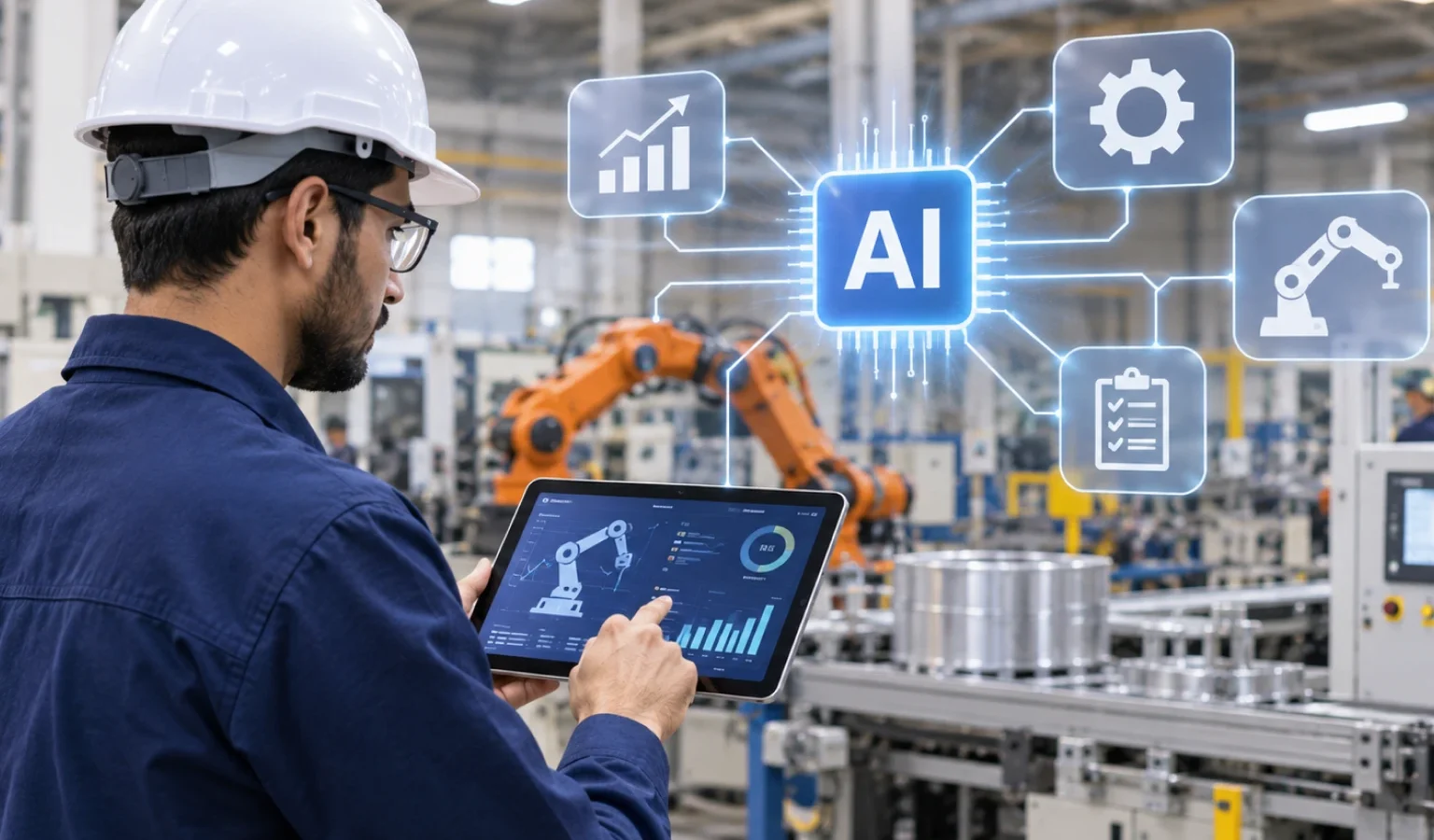
Ask any plant manager what keeps them up at night and the answer is usually the same: a machine that stops at the worst possible time, a batch of defective parts that reaches the customer, or an order that changes three times in one day. The benefits of AI in the manufacturing industry show up right at these pain points. With AI-powered manufacturing automation, software watches the line, spots trouble early and tells your team what to fix before it turns into lost output.
And this is not a future idea anymore. Rockwell Automation’s 2026 State of Smart Manufacturing report surveyed more than 1,500 manufacturers across 17 countries. It found that 59% actively use smart manufacturing technologies in their day-to-day operations, while only 18% are still stuck in pilot mode.
So what is actually changing on the factory floor? Let’s go through it in plain words.
What is AI manufacturing software, really?
Think of it as an extra pair of eyes that never gets tired. Your machines, sensors, cameras and ERP already produce a huge amount of data. AI manufacturing software reads that data all day, learns what “normal” looks like, and flags anything that looks off.
It can predict a bearing failure, catch a scratch on a part, or suggest a better production schedule. That is artificial intelligence in manufacturing at its simplest: using the data you already have to make faster and better decisions.
It also does not replace your team. It gives them answers sooner, so they spend less time chasing problems and more time solving them. For that to work, the software has to plug into your machines, ERP and quality systems, which is exactly what AI integration services are built for.
Where AI in manufacturing is making a real difference
1. Predictive maintenance
Most plants still fix machines in one of two ways: after they break, or on a fixed calendar. Both waste money. One leads to sudden downtime, the other to changing parts that were fine.
AI models study vibration, temperature and power readings and warn you when a machine is heading toward failure. Industry studies often quote a 30% to 50% drop in unplanned downtime, a figure commonly attributed to McKinsey. Your own result will depend on your equipment and data quality, but even a part of that is serious money when one hour of stoppage can cost lakhs.
2. Quality inspection
Human inspectors are good, but nobody can stare at a fast-moving line for eight hours without missing something. Computer vision does not get tired. Cameras and AI check every single part, catch tiny cracks, dents or misalignments, and send an alert in seconds.
This means fewer defective products reaching customers, less scrap and fewer returns. Vendors report defect reductions anywhere between 30% and 80% in documented projects. Treat those as best-case numbers, but the direction is clear. Ready-made tools cover common cases, but plants with unusual parts or processes often need custom manufacturing software development to get inspection that fits their line.
3. Production planning and supply chain
Demand moves, raw material arrives late, a machine goes down. Planning on spreadsheets cannot keep up with that. AI-based planning tools look at orders, stock, machine availability and past patterns, then suggest a schedule that actually works. They also help with demand forecasting, so you hold the right inventory and not too much of it.
4. Energy use and waste
Energy is one of the biggest running costs in a plant. AI can track consumption by machine and shift, point out where power is being wasted and adjust settings in real time. The same approach helps reduce material waste in processes like casting, moulding and packaging.
Put these together and you get what many people call smart manufacturing solutions: a connected factory where machines, people and software work off the same live information. Deloitte’s 2025 Smart Manufacturing survey of 600 US manufacturing executives reported average gains of 10% to 20% in production output and 7% to 20% in employee productivity. Getting there takes people who understand both the models and the factory floor, which is why many plants choose to hire AI engineers instead of building a team from scratch.
How India is doing
Indian manufacturers are not waiting around. In the India findings of the same Rockwell report, 88% of manufacturers said they already use AI or machine learning in operations. About 41% of operations are AI-augmented today, and that share is expected to reach 47% by 2027 and 61% by 2030.
For a country pushing hard on manufacturing, that matters. Faster, cleaner production with fewer defects is a real edge when you compete for global orders.
Why do so many AI projects get stuck?
Here is the honest part. Starting is easy. Scaling is hard.
Deloitte’s AI in Manufacturing 2026 survey found that 84% of manufacturers already get measurable value from AI, yet only around one in five of their use cases has been scaled across sites or the whole company. Parsec’s 2026 survey tells a similar story: 72% have adopted AI in some form, but just 10% have done it at scale.
Why the gap? A few common reasons:
- Messy data. Rockwell found that only 43% of the data manufacturers collect is used effectively. If machines, ERP and quality systems do not talk to each other, AI has nothing clean to learn from.
- One-off pilots. A pilot on one line works, but nobody plans how to roll it out to the other five plants.
- No training. The National Association of Manufacturers’ Q2 2026 survey found that 41% of respondents give frontline workers no AI-related training. If operators do not trust the tool, they will ignore its alerts.
- Old systems. Legacy machines and software that were never built to share data.
None of these are reasons to avoid AI. They are reasons to plan it properly.
How to start without burning your budget
You do not need to transform the whole factory in one go. A practical path looks like this:
- Pick one painful problem. Frequent breakdowns? High rejection rate? Slow changeovers? Start where the loss is easy to measure.
- Check your data. Find out what you collect, where it sits and how clean it is. Fix the basics first.
- Run a focused pilot. Keep it small, set clear targets (for example, downtime hours or defect rate) and track them from day one.
- Connect it to your existing systems. AI that sits outside your ERP, MES and shop floor tools rarely gets used. This is where AI integration services make the difference, because the model has to fit into how your plant already works.
- Train your people early. Show operators and supervisors what the alerts mean and what to do with them.
- Scale what works. Once the pilot shows results, repeat it on other lines and plants.
If your needs go beyond ready-made tools, a system built around your own processes, machines and reporting will work better than bending your process around a generic product. And if you do not have the skills in-house, bring in engineers who already know how to build and deploy models for industrial use.
What comes next
Research firms differ on market size depending on what they count. Fortune Business Insights, for example, puts the global AI in manufacturing market at about USD 9.85 billion in 2026, growing at roughly 38% a year through 2034. The exact number matters less than the direction: money is moving toward AI fast.
Expect more of the following in the next few years:
- Assistants that let a supervisor ask the system a question in plain language (“why did line 3 slow down last night?”) and get a straight answer.
- Digital twins that let you test a schedule or a layout change on a virtual copy of the plant before touching the real one.
- AI quality checks that move from end-of-line to every step of the process.
- More robots and cobots working alongside people, guided by AI.
The manufacturers who gain the most will not be the ones with the biggest budgets. They will be the ones who start small, fix their data and keep their people involved.
Final thoughts
AI in manufacturing is no longer a “someday” topic. Machines that warn you before they fail, cameras that catch defects instantly and planning tools that adapt to change are already running in plants across the world, including many in India. The question now is not whether to use AI manufacturing software, but where to begin.
Pick one problem, prove the result, then grow from there. If you want help figuring out the right first step for your plant, the team at Team In India can help you plan it, build it and connect it to your existing setup.