
A gym owner called us last year with a simple question. He wanted an app, and he wanted to know the price before anything else. Fair enough. But the honest answer depended on about ten things he hadn’t decided yet, and that’s usually how fitness app development conversations start.
If you’re comparing a fitness app development company against a mobile app development company in India, this guide should help you read the quotes you get. We’ll cover what to build, what it costs and where projects tend to go wrong.
The market is big and still growing. One 2026 estimate has fitness apps at around $13.8 billion, with forecasts near $45 billion by 2035. Other firms publish different figures, so treat the numbers loosely. Still, nobody says the market is shrinking.
AI is the reason a lot of new apps feel different. A plain workout library is easy to copy. An AI fitness app that adjusts to each person is harder to copy, and people notice the difference quickly.
What Is an AI Fitness App?
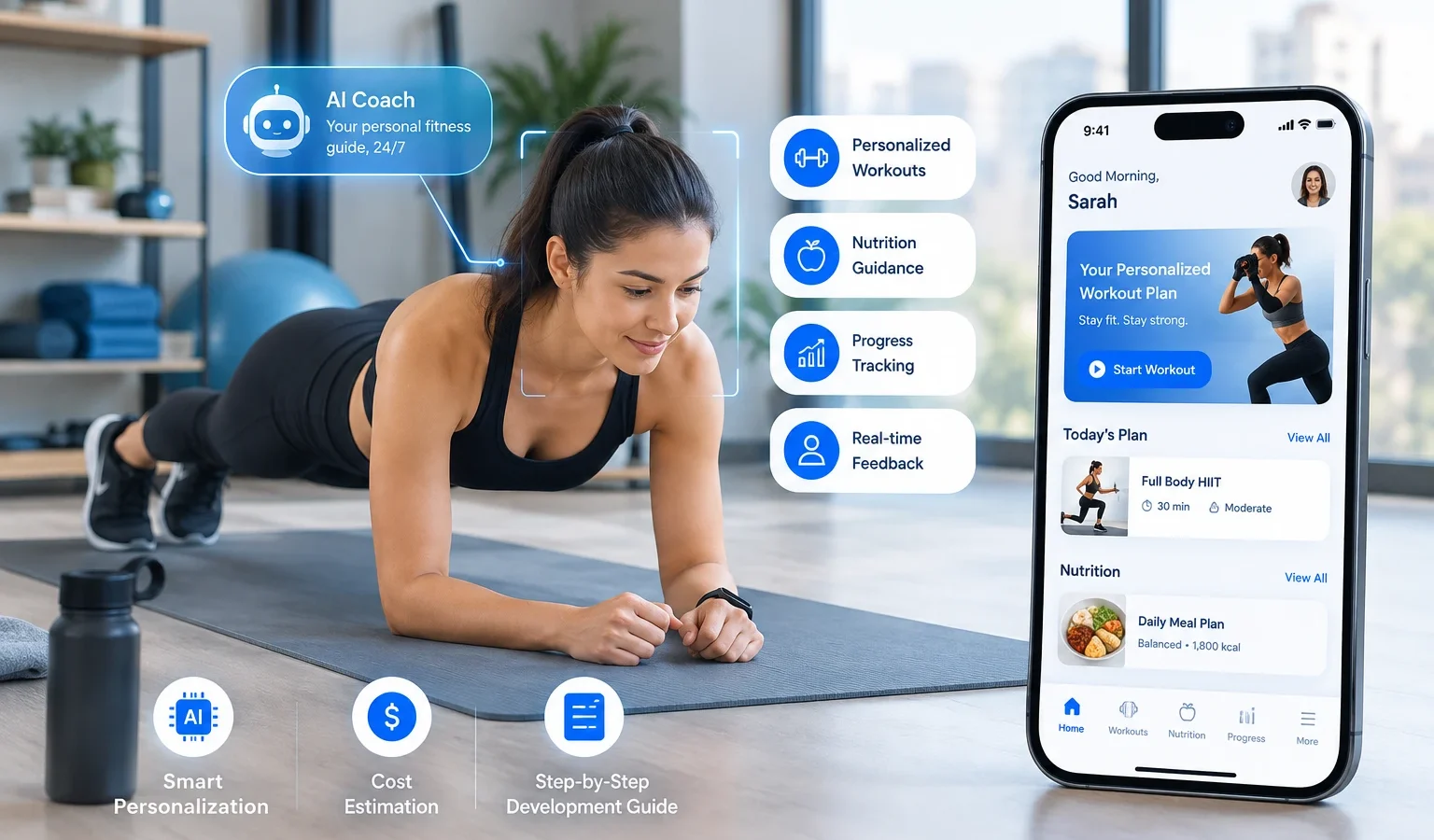
Think of a printed gym chart pinned on a wall. Everyone gets the same one. Now think of a trainer who remembers that you skipped Thursday and your shoulder was sore last week. That second thing is what an AI fitness app tries to be.
Technically it’s a normal app with models behind it. They read what you log, what your watch records and how often you show up, then change the plan. Miss a week and it eases off. Smash a target and it asks for more.
Types of AI Fitness Apps
Decide what you’re building before you list features, because the cost swings a lot depending on the answer.
There is an app for personal trainers with a virtual coach speaking during workouts. The fitness tracker is less complicated, counting repetitions and sets as well as providing graphs. There are nutrition apps that recommend foods based on your current food intake and your goals. Yoga and meditation apps adjust according to your skill level and state of mind. Apps for wearable devices get information from watches and bracelets. And finally, there are form correction apps using the camera and computer vision technology.
Must-Have Features of a Fitness App
Start with the boring stuff, because it matters most. Sign-up should take under a minute. Add profiles, a workout library, progress tracking and push notifications. If the progress screen confuses people, they leave. We’ve seen it happen within days.
The AI layer comes next. Personalized plans are the obvious one. Real-time posture detection is impressive but pricey. A chatbot coach helps people who don’t know what to do next. Predictive analytics can flag users who are about to quit, which is more useful than it sounds. Voice guidance is handy when your hands are busy.
Then some social pull. Streaks, challenges and leaderboards work because most of us show up more when someone can see it.
Benefits of AI in Fitness App Development
The first benefit is that each user feels the app was made for them. That usually means they stick around longer. The second is scale, since one system can coach a hundred people or a hundred thousand without hiring more trainers. The third is data. You get to see what people actually do in the app, which is often not what they say in surveys.
Tech Stack for AI Fitness App Development
No specific solution is correct but there are a few solutions that keep appearing. Either Flutter or React Native will give you both iPhone and Android from a single codebase and it helps you save some money. If you want to go native with your app then you should go with Swift for iPhone and Kotlin for Android. Backend services usually are Node.js or Python services in AWS or Firebase. On the other hand, TensorFlow, PyTorch, MediaPipe and OpenAI API are used for AI.
Short on in-house skills? You can hire AI engineers just for the model work, or bolt smart features onto an existing app with our AI integration services.
Fitness App Development Cost
Everyone wants a number here, so let’s give some. A basic MVP usually lands between $25,000 and $70,000. An advanced app with wearables and heavy AI can pass $150,000, and some reach $300,000. A simple AI MVP with plans and tracking often sits around $40,000 to $70,000 and takes three to five months.
| App type | Typical range (USD) |
| MVP | $25,000 to $70,000 |
| Mid-level (wearables, basic AI) | $50,000 to $80,000 |
| Advanced (computer vision, full AI coaching) | $150,000+ |
What pushes the price up? Mostly the number of features, how smart the AI is, how many platforms you launch on and which outside tools you connect. Camera-based form checking is usually the single most expensive piece.
Where your team sits matters too. Developers in India typically charge about $25 to $60 an hour. US and UK teams charge noticeably more for similar work, and that gap is a big reason startups build here.
To keep spending sane, launch with one feature people really want. Build cross-platform. Leave the fancy AI for version two. And don’t forget upkeep, which usually runs 15 to 20 percent of the build cost every year. More on this in our AI app development costs guide.
Step-by-Step Guide to Fitness App Development
- Pick a niche. Beginner runners, new mothers, desk workers, anyone specific. “Everyone” is too wide to design for.
- Write down every feature idea you have, then cut the list in half. Then cut it again. Most first versions we see are too big.
- Design Keep screens simple, because people use these apps mid-workout with sweaty hands.
- Choose the tech stack based on your features and budget rather than what’s trendy this month.
- Build the AI You can train your own models or plug into existing ones for plans and form checks.
- The actual build, along with wearables, payments and notifications.
- Test properly. Try lots of phones, and try the AI with real people moving around in bad lighting.
- Launch on the App Store and Google Play, then read the first reviews closely. They’ll tell you what to fix first.
- Fix bugs, retrain models and ship updates.
That’s the full workout app development process. A team that has done it before will save you months, so talk to a dedicated mobile app developer before you lock in a plan.
Monetization Models for Fitness Apps
Subscriptions are generally the way to go. Freemium is another option, where exercises are free while the AI coaching is a paid feature. In-app purchases, selling to firms as an employee health benefit program, advertisements, or brand collaborations with companies such as clothing or supplements can be included as well.
Challenges in Fitness App Development
Privacy is the big one. You’ll store health details, and depending on your users, GDPR, HIPAA and India’s DPDP Act may apply. Indian businesses have until May 13, 2027 to comply with the DPDP Rules, so build consent and data deletion early. Adding them later hurts.
AI accuracy is the next headache. A posture checker that fails in dim light is worse than none at all, so test with different body types, angles and lighting.
Retention is hard for everyone. Plenty of people quit within a few weeks. Well-timed reminders and small wins along the way help more than big redesigns.
And then devices. Older Android phones struggle with camera tracking, so set a minimum phone spec early and avoid surprises later.
Conclusion
It is essential that any good app should have a niche, a minimum viable product (MVP), and AI to make users feel recognized by your app. Small beginning, observation of the user activity, and scaling that’s the formula to success. No matter if you are looking for the best company to develop fitness apps or setting your budget, one short discussion is enough.