

Your engineering leaders make many calls and this one of the most common ones in 2026 is whether to go for QA outsourcing vs having an in-house team of QA professionals. A decision usually is based on cost, control, and speed. Whether you outsource QA testing or hire a team of in-house testers, this choice impacts your hiring plan, your budget, and how quickly bugs are fixed before your customers find them. And, if you take actual numbers, the cost comparison of QA offshoring vs keeping QA functions in-house, is the main reason one is preferred over the other. In this article, we discuss two ways – outsourcing and hiring in-house, so that you can choose the one that suits your product, timeframe, and budget.
What Is QA Outsourcing?
QA outsourcing means handing some or all of your software testing to an external company or freelance team instead of hiring testers into your own payroll. It can cover full-cycle testing , functional, performance, security , or just extra hands. Most QA testing services today combine manual testers with automation engineers, and increasingly, AI-assisted test generation tools that speed up coverage
What Is an In-House QA Testing Team?
An in-house QA team is made up of testers you hire, train, and manage directly, usually sitting right inside your engineering group. They know your codebase, your users, and your release calendar better than anyone outside the company ever could. The tradeoff is that you own every cost tied to that: salaries, benefits, software licenses, and the weeks it takes to hire and onboard each person.
QA Outsourcing vs In-House Testing: Key Differences
| Factor | QA Outsourcing | In-House QA Team |
| Cost | Pay per hour or project, low overhead | Fixed salaries, benefits, and tooling costs |
| Access to QA Expertise | Instant access to automation, security, performance specialists | Limited to who you’ve hired and trained |
| Hiring and Training | Handled by the vendor | You manage recruiting and onboarding |
| Scalability | Scale testers up or down within days | Tied to your hiring cycle |
| Testing Tools and Technology | Vendor already owns the stack and licenses | You buy, license, and maintain everything |
| Project Flexibility | Easy to pause, extend, or redirect scope | Fixed team, harder to shift quickly |
| Quality and Risk Management | Depends on vendor process and SLAs | Full visibility, but limited bandwidth |
Pros and Cons of QA Outsourcing
| Pros | Cons |
| Lower cost per hour with no benefits or office overhead | Less day-to-day visibility into how testers actually work |
| Fast access to specialized skills like automation and security testing | Time zone gaps can slow down feedback loops |
| Scales up or down with your release calendar | Takes longer to build deep product knowledge |
| Speeds up time-to-market since you’re not stuck hiring first | Quality depends heavily on which partner you pick |
Pros and Cons of Building an In-House QA Team
| Pros | Cons |
| Testers understand your product, users, and edge cases deeply | Higher fixed costs: salary, benefits, recruiting, tooling |
| Instant communication with no time zone lag | Slower to scale up during launches or crunch periods |
| Full control over process, priorities, and tools | Hiring and onboarding can take months |
| Easier for handling sensitive data and compliance needs | Gaps in niche skills like performance or security testing |
QA Outsourcing vs In-House QA Team: Cost Comparison
Here’s what QA actually costs in 2026, based on current market rates:
| Model | Typical Hourly Rate (2026) | Est. Annual Cost per Tester |
| In-house QA engineer (US, fully loaded) | $45–$65/hr equivalent | $125,000–$145,000 |
| Outsourced QA – Eastern Europe | $35–$85/hr | $73,000–$177,000 |
| Outsourced QA – India / offshore | $18–$45/hr | $37,000–$94,000 |
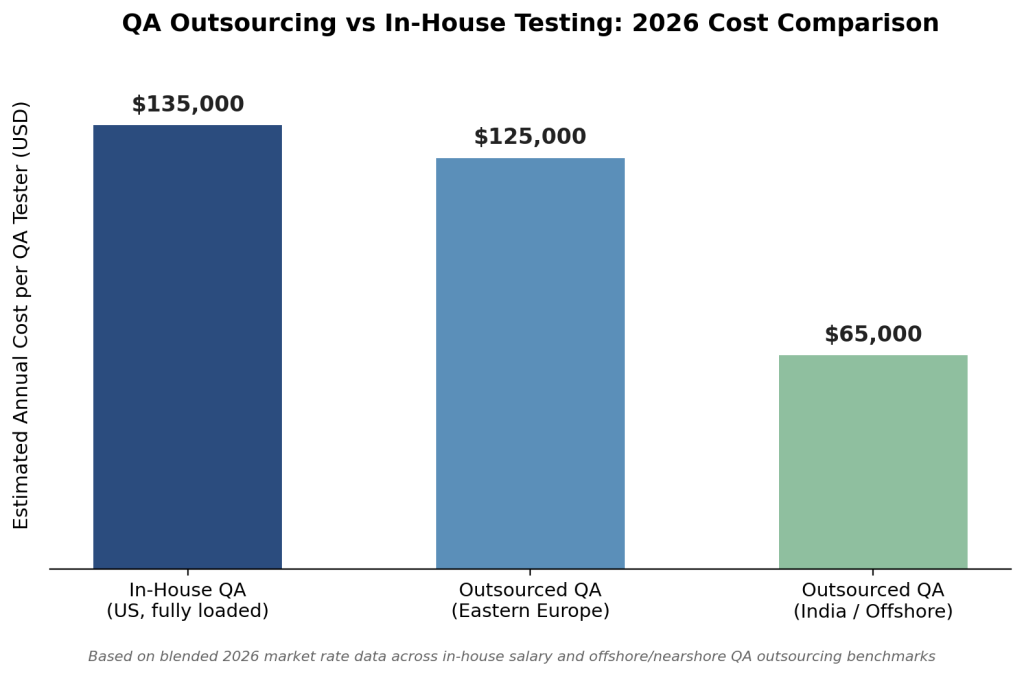
Offshore QA outsourcing typically cuts costs by 40–70% compared to a fully loaded in-house hire, which is a big reason more than half of Fortune 1000 companies now lean on third-party testing partners for at least part of their QA work.
When Should You Outsource QA Testing?
Outsourcing isn’t the right call for every team, but it’s the right call more often than people assume, especially when the real problem is timing or missing skills, not budget. It usually makes sense to outsource software testing when:
- You need to launch fast and don’t have testers on staff yet
- Testing demand spikes around releases, then goes quiet
- You need niche skills like automation, security, or performance testing
- You’re validating a new product and don’t want fixed headcount yet
- Your current team is buried in regression testing before every release
How to Choose a QA Outsourcing Partner
Don’t pick based on hourly rate alone. Check:
- Domain experience in your industry:- fintech, healthcare, SaaS, and so on
- Automation maturity:- ask what share of tests run without someone manually clicking through
- Communication style and how many working hours overlap with your team
- Security certifications if you handle sensitive or regulated data
- References from clients who stuck around past one project
A partner offering dedicated Hire QA & Test Automation support with real automation frameworks in place usually saves you more over a year than whoever quotes the lowest rate.
Conclusion
There’s no single right answer here. If you’re an early stage company , or you need to ramp up testing fast without stacking more people, QA outsourcing is usually the smarter move, particularly if you’re already partnering with an offshore development company for the build side. And if your product is complicated , tightly regulated, or heavily connected to internal systems, then an in-house team can earn back its cost through faster iteration and that kind of institutional memory you can’t really buy. A lot of mid size businesses land somewhere in the middle too: think a small in house lead, paired with outsourced QA for doing the work plus handling the overflow. .
Frequently Asked Questions
Is QA outsourcing cheaper than an in-house team?
yes. Offshore QA outsourcing can cut costs by 40–70% compared to a fully loaded in-house salary, though onshore outsourcing can end up costing more than hiring in-house.
What’s the biggest risk of outsourcing QA testing?
Losing visibility into how testing actually happens. Set clear SLAs, a reporting cadence, and direct access to test results and dashboards to avoid this.
Can I combine outsourced QA with an in-house team?
Yes , this hybrid setup is common. Keep a lead in-house for product knowledge and hand off execution and overflow testing to your outsourcing partner.
How fast can an outsourced QA team start?
Most QA testing services providers can onboard within one to two weeks, compared to four to eight-plus weeks to hire and train an in-house tester.
Does QA outsourcing work for regulated industries like fintech or healthcare?
Yes, as long as the vendor holds relevant certifications (SOC 2, HIPAA, etc.) and can show a documented data-handling process.
