
A good game idea isn’t enough on its own. Projects stall when the wrong platform gets picked, the budget runs out halfway, or nobody plans how the game will earn money. If you need custom game design and development services, or professional game development services that cover design, build and launch, this guide explains what’s included, which platform fits, how the process works and what it costs. You can also see our game development services page.
The market is worth the effort: players are expected to spend $213.9 billion on games in 2026, up 6.1% from last year. New player growth is slowing to 4.4%, though, so games now have to keep the players they already have.
What Are Game Design and Development Services?
Game design vs. game development. Design is the thinking part: the rules, the story, the levels, how the game feels in your hands. Development is the building part: writing code, connecting servers, making it run smoothly on a phone or a PC.
What a full-service game development company covers. A good game design and development company handles both, plus art, sound, testing and launch.
Why Choose Custom Game Development Services Over Ready-Made Solutions?
Templates are cheap and fast. They also look like a hundred other games. Here’s why people still go custom:
- Unique gameplay and brand identity. Your own mechanics, characters and art style.
- Full IP ownership and scalability. The code and the characters are yours.
- Better monetization control. You decide where ads, in-app purchases or subscriptions go, instead of fitting into someone else’s structure.
Newzoo reports mobile downloads fell 25% in the first half of 2026, while the cost per install rose 30% to $0.56. Your monetization has to be built into the game from day one.
Custom Game Design Services: What’s Included
When you hire for custom game design services, here’s what you should expect to see:
- Concept and game design document (GDD). It lists the idea, features, rules, target audience and how the game makes money.
- Level, character and environment design. Level layouts, characters and environments.
- UI/UX design. Menus, buttons, tutorials.
- 2D and 3D art and animation. The visual style, from cartoon-like casual art to detailed 3D worlds.
- Sound design and music. A good tap sound makes a game feel good.
Game Development Services for Different Platforms
Newzoo says strategies that work on one platform may not carry over to another.
- Mobile (Android and iOS). Mobile is forecast at $121.1 billion, about 57% of the whole market. In India, over 600 million people now play games, and most of them play on a phone.
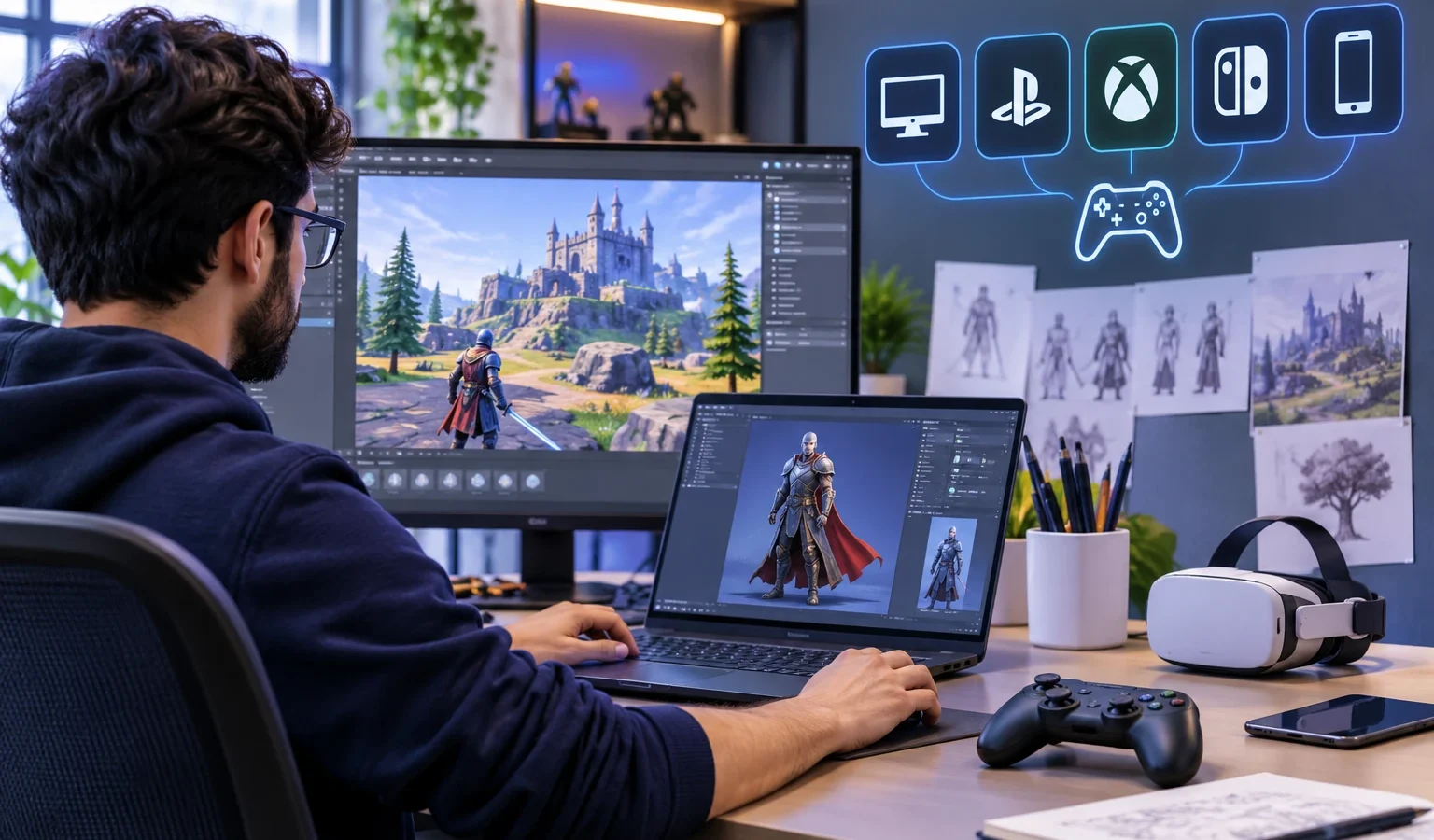
- PC and console. Better for complex, graphics-heavy or premium titles. PC is forecast at $45.9 billion and console at $46.9 billion this year.
- Web and browser-based (HTML5). No download needed. Great for quick campaigns, brand games and casual play.
- AR/VR and metaverse. Smaller audience, but strong for training, events and immersive brand experiences.
- Cross-platform. Build once, release on multiple platforms. Saves money, but only if planned early.
Types of Games a Game Development Company Can Build
- Casual and hyper-casual: quick to build, easy to play, usually ad-supported.
- Multiplayer and real-time: need strong servers and careful testing.
- Educational and gamified apps: learning, fitness or loyalty apps that borrow game mechanics.
- Blockchain and NFT games: niche, and the rules keep changing, so go in with your eyes open.
- Fantasy sports, casino and card games: popular, but regulations differ by country and state.
Technologies and Game Engines Used
The engine is the base your game runs on.
- Unity: the most common choice for mobile, 2D and AR/VR.
- Unreal Engine: best for high-end 3D graphics on PC and console.
- Godot and Cocos2d: lightweight options for smaller 2D games.
- Backend, multiplayer servers and cloud tools: the hidden part that handles player accounts, leaderboards, saves and live updates.
The Game Development Process: Step by Step
- Idea validation and pre-production. We test whether the idea has an audience before spending big money.
- Prototyping. A rough playable version. Is it fun?
- Design and development. Art, code and sound come together in sprints, with regular builds for you to try.
- Testing and QA. Bugs, crashes, slow devices, odd screen sizes. Android alone has thousands of device types.
- Launch and post-launch support. Store listing, release and then updates based on player feedback.
How Much Do Custom Game Development Services Cost?
Anyone who quotes you a fixed number without asking questions is guessing.
What affects the cost. Platform, game complexity, art style (3D costs more than 2D), multiplayer, number of levels and the backend you need.
Rough ranges. As a ballpark, a simple hyper-casual game can start around $5,000 to $20,000. A polished casual or mid-core 2D/3D game usually lands between $30,000 and $150,000. Large multiplayer or high-end 3D projects go well beyond that. Treat these as starting points, then ask for a proper quote.
Ways to save. Start with a minimum playable version, pick one platform first, reuse assets where possible and add features after launch based on what players actually use.
How to Choose the Right Game Design and Development Company
A few things worth checking before you sign:
- Portfolio and experience. Have they shipped games like yours?
- Technical expertise. Do they know the engine and platform you need?
- Communication and transparent pricing. Clear milestones, regular demos, no surprise bills.
- Post-launch maintenance and support. Ask who handles updates.
Why Partner with Team In India for Game Development Services
We work as one team across design, development and testing.
- Experienced designers and developers who work on your game from concept to launch.
- End-to-end custom solutions for mobile, web, PC and immersive platforms.
Visit our game development services page and tell us about your idea.
Common Challenges in Game Development and How to Overcome Them
- Scope creep. New features keep getting added. Fix: lock the first version and keep a separate wish list.
- Poor player retention. Fix: test the first five minutes of gameplay again and again.
- Device fragmentation. The game runs on your phone but crashes on another. Fix: test on real, budget devices too.
- Weak monetization. Fix: plan it in the design stage, not after launch.
Future Trends in Game Development
- AI-driven gameplay. Smarter non-player characters and faster content creation.
- Cloud gaming. High-end games on low-end phones, which matters in markets like India.
- Web3 and play-to-earn. Still experimental.
- Immersive AR/VR experiences.
Conclusion
Know your platform, set a realistic budget, plan monetization early and pick a partner who stays with you after launch. If you’re ready to turn your idea into something people can play, our game development services team can help. Get in touch with our team for a free consultation.
FAQs
What are custom game development services?
They cover building a game made specifically for you, from design and art to coding, testing and launch, instead of reskinning a ready-made template.
How long does it take to develop a custom game?
A simple casual game can take 2 to 4 months. A mid-level 3D or multiplayer game often takes 6 to 12 months or more.
How much does it cost to develop a game?
It depends on the platform, complexity and art style. Simple games start in the low thousands of dollars, while bigger projects run into six figures.
Which platform is best for my game?
Mobile suits most audiences and budgets. Choose PC or console for graphics-heavy games, and web for quick, shareable experiences.
Do you provide post-launch support and updates?
Yes. Bug fixes, new levels, performance tuning and feature updates are part of keeping a game alive.
Who owns the IP of the game?
You do. Your code, characters and designs should belong to you, and the agreement should say so clearly.