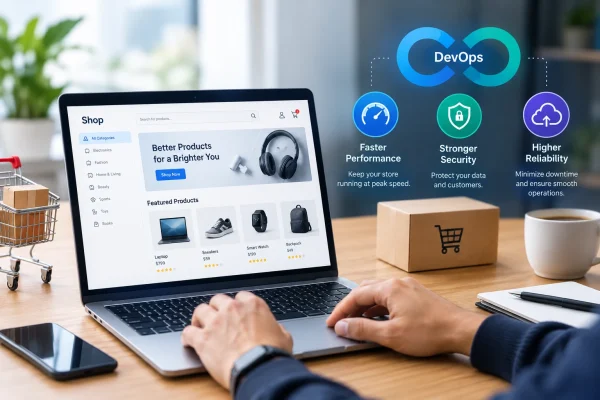


Say you run a 40-person distribution company. Orders arrive by email and WhatsApp, one person types them into Excel, and accounts types them in again. It works. Mostly. Then you open a second warehouse and things start to leak. That’s usually when owners go looking for custom software for businesses to grow beyond off-the-shelf tools, and for custom software development services in India that won’t blow the budget. Below is what it actually does, what it costs and how to pick a partner. If you want the full service list, it’s on our software development services page.
What Is Custom Software Development?
Software made for one business. Yours. Not a product sold to ten thousand companies with a settings page, but a system that follows how your team already works: your approval steps, your pricing rules, your reports. CRMs, ERPs, HR systems, inventory tools, online stores and customer apps are the usual suspects. And because you own it, nobody can hike the price next year or quietly drop a feature you depend on.
5 Ways Custom Software Development Helps Businesses Grow
Automate repetitive tasks and cut operating costs
Typing the same data into three places is the easiest thing to get rid of. Invoices, stock alerts, payment reminders and weekly reports can all run on their own, and software doesn’t slip a decimal point. Fewer mistakes means fewer awkward calls to customers. Your accountant would also rather chase an overdue payment than build the same sheet for the fifth Monday running.
Improve efficiency by connecting all processes in one platform
Sales has one list, the warehouse has another, accounts has a third. Sound familiar? On one platform, a sale updates stock and raises the invoice in the same step. Nobody has to message around asking which file is the right one.
Make better decisions with real-time dashboards
How long does it take you to find out what you sold yesterday? If the answer is “when the report comes in”, you’re steering by old numbers. A live dashboard shows sales, stock and pending payments as they stand today, so a problem gets spotted while it’s still small.
Deliver a better customer experience
Nobody enjoys phoning a company to ask where their order is. Let customers track it, book a slot or raise a ticket from their phone and they’ll notice. Usually they stick around longer too.
Scale without rebuilding from scratch
This is where ready-made tools tend to trip. You add a branch, then a product line, then a payment gateway, and the tool starts fighting you. Software built around your plans can take on new users, integrations and later even AI features without a rebuild.
Custom Software vs Off-the-Shelf Software
Ready-made tools are perfectly fine for standard jobs like email or basic bookkeeping. The gap opens when your way of working isn’t standard.
| Custom Software | Off-the-Shelf Software | |
| Fit | Built around your process | Built for the average user |
| Customization | Full control | Limited to the settings page |
| Integrations | Connects to what you already use | Only what the vendor supports |
| Cost in year one | Higher | Lower |
| Cost over 3-5 years | Often lower, no per-user fees creeping up | Grows with every user and add-on |
| Security | Designed around your data and rules | Shared with every other customer |
| Ownership | You own the code | You rent access |
Custom Software Development Trends for 2026-27
Money is following demand. Mordor Intelligence puts the global custom software market at about $50.9 billion in 2026, growing roughly 17.9% a year through 2031, with smaller businesses growing faster at around 20%. So what are people building?
- AI inside their own tools: reading documents, forecasting stock, answering routine support questions.
- Cloud-native apps: cheaper to run, easier to scale and update.
- API-first design: payment, logistics and accounting tools connect without workarounds.
- Security from day one: IBM’s 2026 report puts the average data breach in India at a record ₹25.5 crore, up almost 16% in a year. Bolting security later gets expensive.
- Low-code plus custom code: low-code for simple screens, proper code where your business is different.
Industries Benefiting Most from Custom Software
Healthcare (patient records, appointments), fintech (payments, compliance), retail and e-commerce (inventory, customer apps), logistics (tracking, routes), education (learning platforms) and manufacturing (production, quality checks). The common thread is rules that ready-made tools keep getting slightly wrong.
How Much Does Custom Software Development Cost?
Anyone who quotes you a number before asking questions is guessing. Cost moves with scope, the number of platforms, integrations, compliance needs and who’s on the team. Budget for surprises too: industry surveys suggest many projects overshoot by 25-45%, mostly because the requirements weren’t clear at the start.
Where the team sits matters a lot. Vendor rate surveys for 2026 put Indian developers at roughly $25-60 an hour, against $150-300 in the US. Take those as ballpark figures and get a written quote based on your own requirements.
How Long Does It Take to Build Custom Software?
A focused first version often takes 8-14 weeks. Bigger platforms run to several months. Clear requirements and quick feedback save more time than adding developers ever will. We’ve broken it down by project type in our guide on how long it takes to build custom software.
Why Businesses Choose Offshore Development in India
Nasscom expects India’s tech industry to hit about $315 billion in FY26 with around 5.95 million people on payroll. That’s a big talent pool, which is why a software development company in India can usually staff a project fast. Costs are lower, working hours overlap with the US, UK and Middle East, and the team can grow when you need it to. More on that in why businesses choose offshore development.
How to Choose a Custom Software Development Company
Technical expertise
Have they built in your tech stack before? Ask, don’t assume.
Portfolio and case studies
Look at real projects in your industry. If you can, speak to a past client.
Scalability
Ask what happens when you have ten times the users.
Security and compliance
Get answers on access control, encryption, backups and testing, in writing.
Support and maintenance
Software needs looking after once it’s live. Find out who fixes things at 11 pm and what that costs.
When to Hire a Software Developer in India
There are two usual ways to work. Project-based suits a defined build with an end date. A dedicated developer suits ongoing work, where someone learns your product and sticks with it. If your roadmap keeps growing, it’s normally cheaper to hire software developers in India on a dedicated basis than to keep starting over with new vendors.
Conclusion
Custom software won’t fix a broken process. It will stop your tools from holding back one that works. Start small, build whatever hurts most right now, and add to it later. If you want a second opinion on where to begin, talk to us about our software development services and we’ll work it out with you.