
Ask anyone in India who has seen more than one doctor and they’ll probably describe the same ritual: a plastic folder stuffed with old lab reports, carried from clinic to clinic because no two systems share anything. Doctors aren’t thrilled either. They repeat the same questions, hunt for last month’s prescription and lose a chunk of every day to admin. That gap is exactly why so many founders want to build a healthcare app right now.
If you’re one of them, this guide covers how to build a healthcare app step by step, from picking a model to launch day. We’ll also get into money, including healthcare app development cost in India, since budget usually decides what version one looks like. Run a clinic, a hospital group or a healthtech startup? Either way, you should finish with a plan you can act on.
Why Healthcare Connectivity Apps Matter
One doctor has your history, one lab has your reports and one pharmacy has paper slip. The toll is repeated tests, missed follow-ups and dropouts.
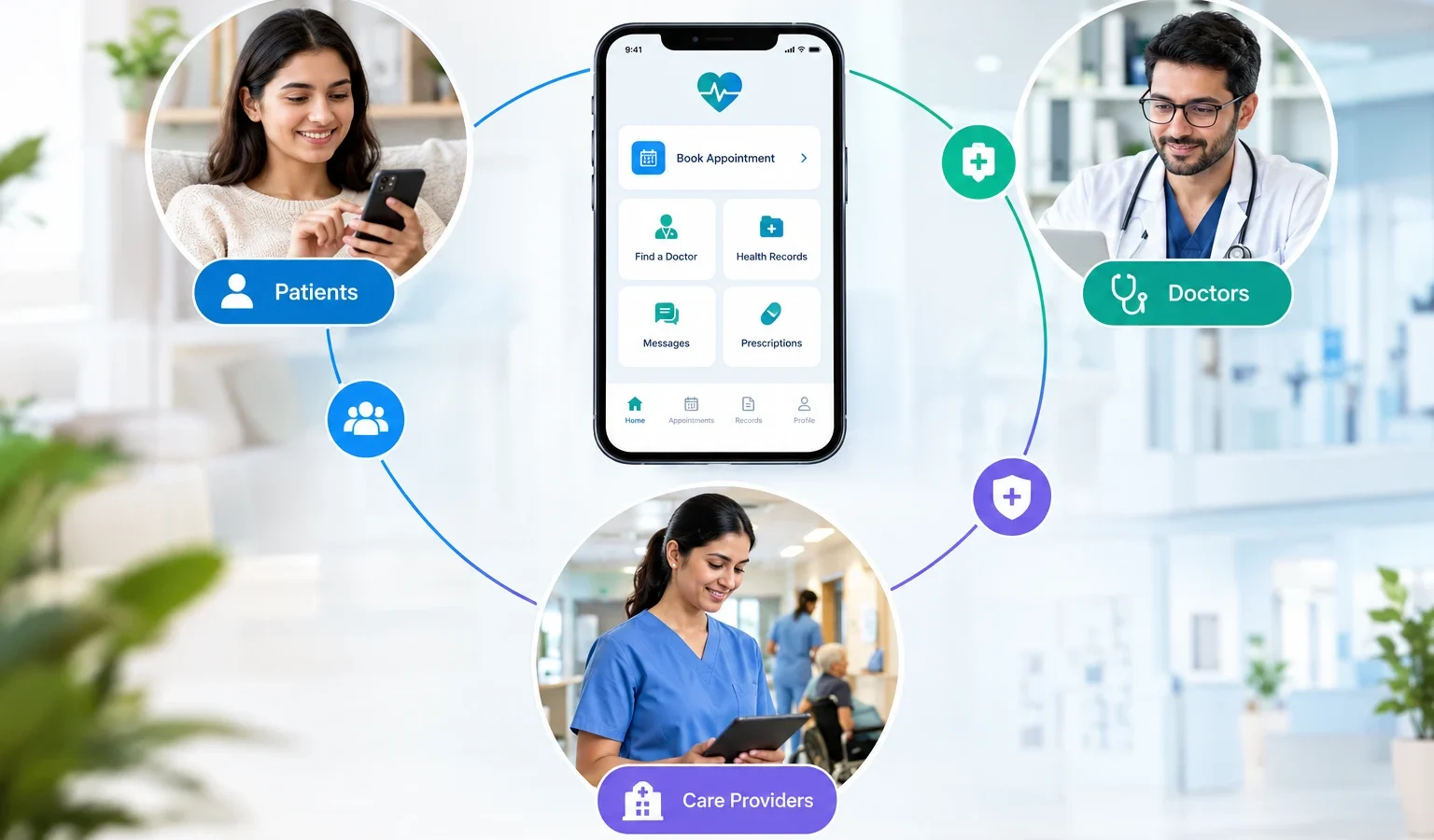
A connected app works a bit differently for each party: patients get appointments, video visits, charts, and reminders all in one place. Doctors get their schedules, patient charts and history in a second, and can send e-prescriptions with a few clicks. Hospitals, labs, pharmacies, and clinics experience fewer missed appointments and gain greater insight into their day-to-day operations.
India is an ideal test bed for this. Smartphones are ubiquitous, specialist services are unevenly available outside the metropolises, and the Ayushman Bharat Digital Mission (ABDM) is encouraging the entire system to go digital.
Types of Healthcare Apps You Can Build
Before you start healthcare mobile app development, pick the model that fits your goal. The common ones:
• Telemedicine apps for video, audio or chat consultations.
• Appointment booking apps where patients find a doctor and grab a slot.
• Remote patient monitoring apps that pull in vitals from wearables and home devices.
• Care coordination and engagement apps for reminders, care plans and team messaging.
• Marketplace apps like Practo that bundle doctor discovery, teleconsultation, pharmacy and lab tests.
Most successful products don’t launch with all five. They start with one, get it right, and add the rest later.
Must-Have Features of a Healthcare App
A connected platform usually has three faces: one for patients, one for doctors and one for whoever runs the system.
Patient app
Patients need quick sign-up, a doctor search they can filter by specialty, city, language and fees, and easy booking or rescheduling. Add video, audio and chat consultations, a place to see past prescriptions and reports, safe in-app payments, and reminders for appointments and medicines.
Doctor app
Doctors care most about control over their time. Give them availability settings, patient profiles with consultation history, built-in video, quick e-prescriptions and a simple view of earnings.
Admin and care provider panel
Behind the scenes, someone has to verify doctors, manage billing and appointments, send notifications and watch the numbers. If you’re running labs, pharmacies or multiple clinics, this panel handles those too.
Advanced features worth planning for
Once the basics work, think about an AI symptom checker, wearable integration, multiple languages (this matters a lot in India), insurance claims and a support chatbot. None of these belong in version one unless they’re your whole pitch.
Step-by-Step Process to Build a Healthcare App
Step 1: Talk to your customers. Find out what your competitors aren’t getting right, then determine who to put first: doctors, patients, hospitals, or all three. Speak to some real doctors and patients before creating your specifications, their responses may just surprise you:
Step 2: Select one app model. Select one of your options listed above and write the one problem your app solves best. Trying to do everything is the biggest reason healthcare projects get stuck.
Step 3: Design for everyone. Whether your user is a busy surgeon or a grandmother trying to get to grips with a phone for the first time, simple screens, legible text and clear core functionality are essential.
Step 4: Establish an MVP. Focus on registration booking video consultation, and payments. An initial minimal product allows you to get live reactions quickly and to limit early expenditure.
Step 5: Test hard. Performance is one thing, known for a bit of extra effort, you also want to go many extra yards over security and compliance issues. Its your ballgame handling health data so you better test for vulnerability.
Step 6: Launch, then iteratively improve. Launch on iOS and Android, learn from actual usage, ship daily/weekly updates. And invest in yearly maintenance capacity, typically a set percentage of the cost of the initial build.
Want a team to walk you through these steps? Explore our Healthcare App Development Services.
Tech Stack for Healthcare App Development
There’s no single right stack. It depends on your scale, budget and compliance needs. Here’s a setup we see often:
| Layer | Common Options |
| Mobile (cross-platform) | Flutter, React Native |
| Mobile (native) | Swift (iOS), Kotlin (Android) |
| Backend | Node.js, Python (Django), Java (Spring Boot) |
| Database | PostgreSQL, MongoDB |
| Cloud | AWS, Microsoft Azure, Google Cloud (with healthcare-compliant configurations) |
| Video and chat | Twilio, Agora, WebRTC-based solutions |
| Payments | Razorpay, Stripe |
| Notifications and maps | Firebase, Google Maps API |
For an MVP, cross-platform frameworks like Flutter or React Native are usually the practical pick. One codebase means lower cost and a faster launch.
EHR and Third-Party System Integration
An app that can’t reach existing data is just another silo. Integration is what lets yours talk to hospital software, labs and pharmacies.
Start with EHR/EMR integration, which syncs patient records with whatever the hospital already runs. For data exchange, you’ll run into HL7 and FHIR. HL7 is older and still common, but FHIR is API-friendly and the one to design around today. Labs, pharmacies and insurers can then plug in for test booking, medicine orders and claims.
In India, add ABDM to your list. It lets users link their ABHA health ID and share records through the national ecosystem, with their consent.
Security and Compliance: HIPAA, GDPR and DPDP Act
Health data is one of the most sensitive types of personal data out there. And the rules differ according to where your users are. For example, if you’re storing protected health information for patients in the US, then [HIPAA] rules apply; if you’re operating in the EU, then [GDPR].
On the technical side, plan on encryption, role-based access, multi-factor login, audit logs, frequent penetration tests and solid backups. One suggestion: plan for compliance from the very first sprint. Adding the controls afterwards is remarkably costly.
Healthcare App Development Cost and Timeline
Healthcare app development cost in India swings widely based on features, platforms, integrations, compliance and who builds it. Treat these figures as rough ranges, not quotes:
| App Complexity | Example | Approx. Cost (India) | Approx. Timeline |
| Basic MVP | Appointment booking, basic profiles | ₹8–15 lakh | 3–4 months |
| Mid-level | Telemedicine, payments, e-prescriptions | ₹15–35 lakh | 4–7 months |
| Advanced | EHR integration, AI, wearables, multi-role platform | ₹35 lakh+ | 7–12 months |
What moves the number most? The count of user roles, whether you’re building for iOS, Android and web, how many outside systems you connect, how strict your compliance needs are, and whether AI or IoT features are involved. Team size and experience matter too.
Want the detailed breakdown? Read our healthcare software development cost, process and features guide.
How to Choose the Right Development Partner
A good healthcare app developer will take you several months down the road, while a bad one might leave you in the dust. Request work they’ve truly delivered, and ensure they have hands-on expertise with GDPR HIPAA DPDP and you’ve understood them well, not just in a slide. Experience with integrations with EHR & FHIR, open pricing transparency after-launch support, and references from past clients are necessary.
It is also time to select a working model. An in-house development team allows for more control but is costly and time-consuming to hire and manage. You could go for an agency, which will help you to start faster and will provide you with domain knowledge on top of manageability. Or hire dedicated app developers as it would be like hiring an extension of your own team minus the hiring hassle.
Common Challenges and How to Overcome Them
Privacy and interoperability. Use standards like FHIR and treat security as a day-one job.
Getting doctors and patients to actually use it. Involve doctors in design, keep workflows short and offer onboarding help. An app that adds clicks to a doctor’s day won’t survive.
Scaling and upkeep. Build on cloud infrastructure and plan regular updates as your user base grows.
Changing regulations. Work with a partner who follows rule changes across the regions you serve.
Future Trends in Healthcare App Development
A few things are worth watching. AI is getting better at triage, early risk flags and personalised care plans. Wearables are making continuous monitoring practical for chronic conditions and elderly care. Voice and multilingual interfaces are opening apps up to people who struggle with text-heavy screens. And in India, ABDM should make consent-based record sharing between providers far easier over the next few years.
Conclusion
It is a few smart decisions when building a connected healthcare platform: select a singular approach, hold the MVP tight, allow for early compliance and collaborate with healthcare savvy partners. If these are any measure, you will be able to create a healthcare app that tidies up a doctor’s workflow, makes it easier for a patient and helps providers grow.
Ready to start? Talk to our healthcare app development experts at Team In India for a free consultation.