
Almost every founder asks the same thing first: what is the cost to develop an e-learning app, and is it worth it? Short answer: yes, if you pick a clear niche and start small. Learning apps are no longer a side bet. They are one of the few app categories where people pay month after month, and they keep coming back.
This guide covers what the big three do differently, the features you need, the tech stack, the steps, and the money.
Why continue to establish eLearning in 2026?
People are still registering massively, so why do more people need to register for the class? The USD market for online learning was worth USD as of 2025, as a recent report by analysis firms and is expected to grow further over the next few years.
Pay attention to the executives. Duolingo’s daily active users surged 23% from Q2 2025 to Q2 2026 to 58.7 million, and paid users numbered 12.7 million. Coursera last month finalized its merger with Udemy, which now gives it access to 290 million learners. Plus, Coursera says more than a human has enrolled in a generative AIl course on average every three seconds so far this year.
Now, there’s demand. But how do you create an eLearning app to grab some of it?
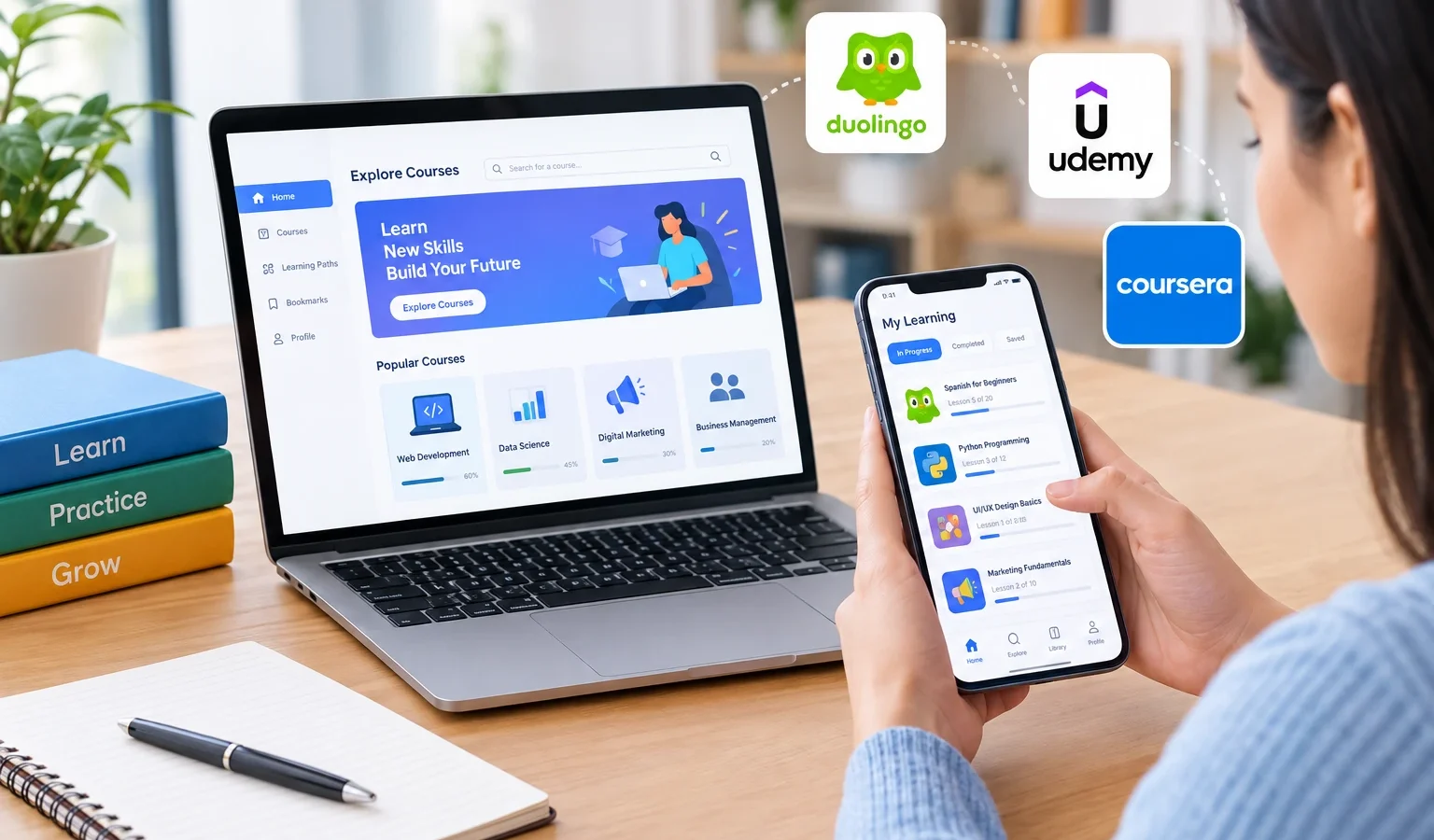
Duolingo vs Udemy vs Coursera: what is the difference?
They appear similar, but they were three different products.
Duolingo is about habit. Short lessons streaks XP, leader boards. At its peak in Q2 2026, 84% of users would return the next day, all of which is backed by strong intuitive design over quality lessons.
Udemy is a marketplace. Anyone can publish a course and students buy what they want. Your job is to bring teachers in and take care of the course catalog.
Coursera is about credentials. University partners certificates degrees, and loads of enterprise training.
Choose one model before you build software. Combining all three in your first release is how budgets get blown.
Features your eLearning app needs
Think in three parts: a learner app, an instructor panel, and an admin panel.
For learners:
- Sign-up with email, phone, or Google
- Course catalog with search and filters
- Video and audio lessons with offline download
- Quizzes, assignments, and progress tracking
- Certificates
- Push notifications and reminders
- In-app payments and subscriptions
For instructors:
- Course upload and lesson builder
- Student analytics and earnings dashboard
- Q&A and messaging
For admins:
- User and course management
- Payout handling
- Reports and content moderation
Want to stand out? Add personalization. An app that adjusts lessons to each learner feels very different from one that shows everyone the same list. Gamification helps too, but only if it fits your audience. A streak system works for language learning. It may feel silly for a CPA exam course.
Which tech stack should you pick?
There is no single right answer, but this setup works for most teams:
| Layer | Recommended Option | Why It Works |
| Mobile (cross-platform) | Flutter or React Native | One codebase for Android and iOS, lower cost |
| Mobile (native) | Kotlin (Android), Swift (iOS) | Best performance for heavy video or animations |
| Backend | Node.js or Django | Fast to build, easy to scale |
| Database | PostgreSQL, Redis for caching | Reliable data storage and quick loading |
| Video Streaming | Managed video streaming service | Smooth playback on slow networks, no own servers |
| Cloud Hosting | AWS, Google Cloud, or Azure | Grows with your user base |
| Payments | Payment gateway + in-app purchase | Covers cards, UPI, subscriptions, iOS and Android billing |
If your audience is split between platforms, plan for both. You can hire Android app developers and hire iOS app developers separately, or go cross-platform and save budget at the start.
How to build an eLearning app: step by step
1. Select your niche. “Learning for everyone” is not a niche. “Spoken English for working professionals in India” is.
2. Examine your competition. Get five applications from your category. Read through the one-star feedback. This is free market research.
3. Determine your revenue streams. Will users subscribe? Pay per course? Watch ads? Or go enterprise? Which model influences your feature sets.
4. Build the MVP. Core lessons, one payment method, basic progress tracking. Nothing more.
5. For the thumb. Most learners learn from their phone, on the bus, in short sessions. Short lessons, keep screens clutter free.
6. Test with real learners. Fifty people using it will teach you more than six months of planning.
7. Launch measures improve. Watch where learners drop off, then fix that first.
How much does eLearning app development cost?
Honest answer: it depends, and quotes vary a lot between agencies. Here is a range that matches what most 2026 guides report:
| App Type | Estimated Cost | Timeline | Best For |
| Focused MVP | $40,000 – $80,000 | 3 – 5 months | Startups testing an idea |
| Scalable Platform | $80,000 – $180,000 | 5 – 8 months | Growing products with real users |
| Enterprise Solution | $180,000 – $350,000+ | 8 – 12 months | Large platforms with live classes, analytics, integrations |
A few things push these numbers up or down:
| Cost Factor | Impact |
| Number of platforms (Android, iOS, web) | Each extra platform adds cost |
| Live classes and video volume | Higher hosting and development effort |
| AI features and personalization | Adds roughly 25 – 30% to base cost |
| Third-party integrations | Adds time and testing |
| Maintenance after launch | 15 – 20% of development cost per year |
For a deeper breakdown, see our guide on the cost to build an education app.
Mistakes to avoid
- Building every feature before launch
- Ignoring video quality on slow networks
- Skipping offline mode
- Forgetting content. A great app with weak courses loses fast.
Ready to build?
Duolingo, Udemy, and Coursera didn’t get big overnight. They started to focus. Take one simple thing and expand!
If you want a team who has created learning products before, look into our eLearning app development services and speak to us about your idea. We will help you scope an MVP to suit your budget and your learners.