

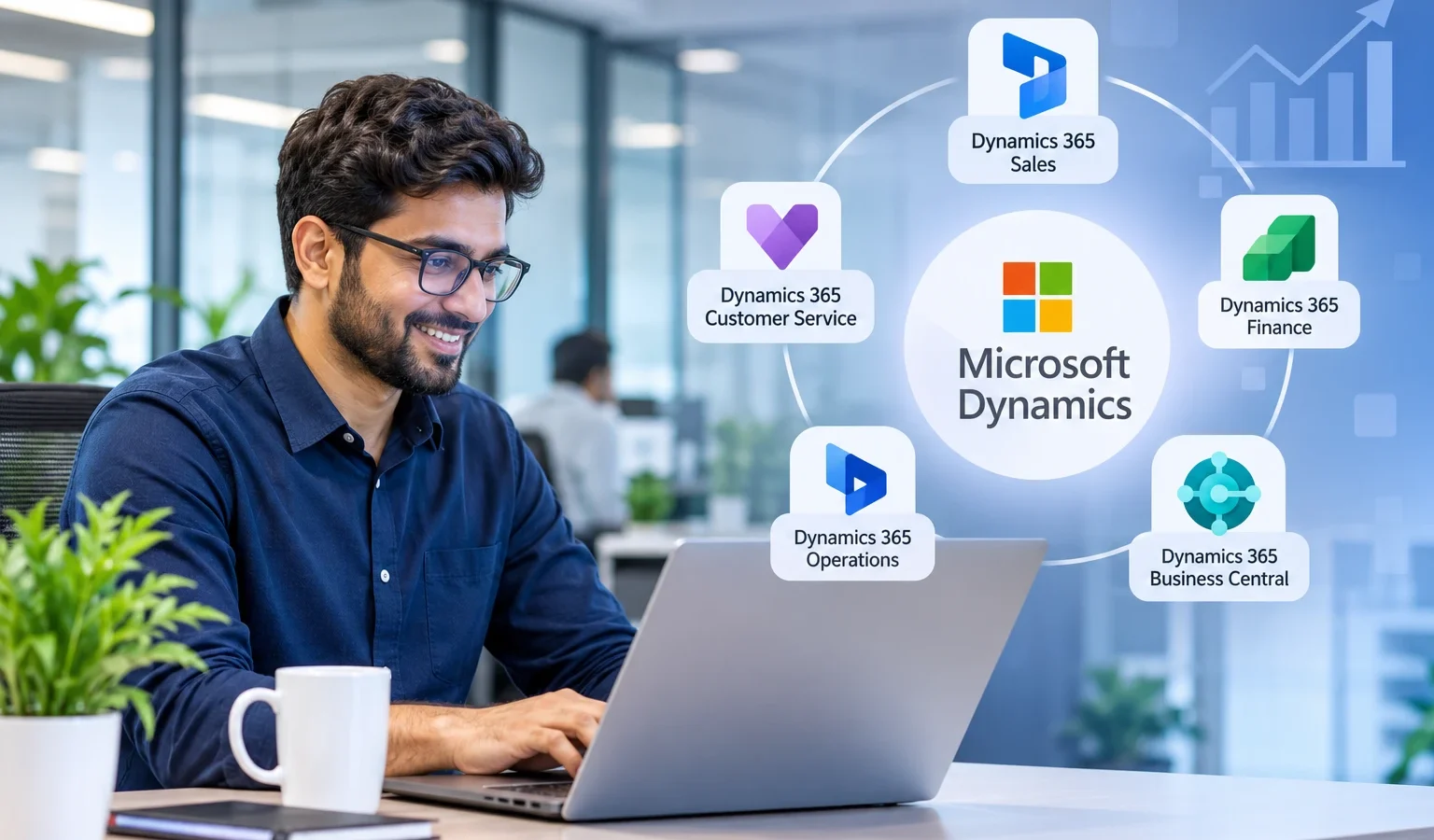
The failure of most Dynamics 365 projects. It isn’t the software, it’s the second stage a project gets left by the wayside when someone realizes the standard screens don’t accurately reflect how the sales team really quotes, or invoices continue to be exported to Excel every Friday. That is where Microsoft Dynamics 365 development services come into the picture. And if you’re after a custom Microsoft Dynamics development company in India, this article explains what the work entails, what it costs, and where people go wrong.
What Are Microsoft Dynamics Development Services?
Short version: anything you do to Dynamics 365 at any time after you’ve bought the licence. Custom fields, new apps automation data moves, reports. And someone to fix it when it breaks on a Tuesday.
Dynamics 365 is Microsoft’s business suite. CRM on one side (sales service marketing), ERP on the other (finance, supply chain, operations). Most people still refer to the first half as “Microsoft Dynamics CRM” and that’s okay. We all understand what you are talking about.
Implementation and development get mixed up a lot. Implementation gets you live. Development is what happens in month eight, when the finance head wants one more approval step. You’ll end up needing both.
Why Businesses Invest in Microsoft Dynamics 365
Get your stats out of the way first. Microsoft announced 13% growth on Dynamics 365 in the quarter ending June 30, 2026. And in the fiscal quarter ending September 30, it acknowledged bookings easing when it posted 10% growth on its industry solutions cloud (and yes, that cloud includes Dynamics 365). Still, Dynamics 365 is still growing at a solid rate even that big? Firms love it.
Unified CRM and ERP in one platform
Picture sales promising delivery by Friday. The warehouse never heard about it. Finance then bills a different amount. That happens daily where CRM and ERP live apart. Put both on one customer record and most of those arguments simply disappear.
Scalability and Microsoft ecosystem integration
It plugs into Outlook, Teams, Excel, Power BI and Azure, tools your staff already have open. AI agents are the new push as well. Microsoft’s 2026 release wave 1 added agents in Business Central for sales and purchase tasks. They still need setting up around your data and your rules, though, and that setup is development work.
Core Microsoft Dynamics Development Services
Custom application development
When a standard screen won’t cut it, a developer builds a custom app inside Dynamics. Say a distributor wants reps to log a site visit, with photos, from a phone. Doable. Just not out of the box.
Dynamics 365 customization and configuration
Fields, forms, dashboards, security roles, business rules. Dull work, honestly, but it’s the part your team touches all day, so it matters more than it looks.
Plugin and workflow development
This is background automation. A deal is marked won, an invoice draft appears, the account manager gets pinged and finance gets a task. Nobody clicks anything.
Third-party and Office 365 integration
Your website, payment gateway, courier tool and that ancient billing software all hold data you need. Good Dynamics 365 integration services link them so the data moves by itself. Typing one order twice is exactly how errors sneak in.
Data migration and upgrades
Coming from an old CRM, NAV, GP or a pile of spreadsheets? Migration is when you learn how messy your data is. Duplicate customers are the usual shock. Clean first, move second.
Power Platform (Power Apps, Power BI, Power Automate)
Power Apps for small apps, Power Automate for repeat tasks, Power BI for reports people will actually open. All of them sit on the same data as Dynamics.
Support and maintenance
Microsoft ships two release waves a year, April to September and October to March. Your custom work has to survive each one, so somebody needs to be watching.
Dynamics 365 Modules Businesses Commonly Customize
Sales, Customer Service, Marketing
Lead scoring, quote approvals and case routing get changed the most.
Finance and Operations
Larger firms rework approval chains, multi-entity reports and compliance rules here.
Business Central
The small and mid-size ERP. Teams usually extend it for inventory, pricing or industry-specific reports.
Field Service and Supply Chain
Technician scheduling, asset tracking and warehouse flows.
Key Benefits of Professional Dynamics Development
That’s really the win: you modify the software once instead of continuously training people. In addition, you’ll do less copy-paste, have one record per customer (not five), and get self-updating reports. Upgrades are less painful, too: custom work built in the supported fashion doesn’t break when Microsoft releases a new version.
Industries That Benefit Most
For production planning, Manufacturers rely on it to identify and source suppliers. For Merchants and Retailers, it visualizes inventories, orders, and customers both in retail outlets and on the web. Clinics and hospitals manage appointment scheduling and follow up, while Financial institutions and consultants manage onboarding and audits.
How the Development Process Works
Wondering what actually happens once you sign? Roughly this:
- Discovery. The team sits with your people and learns the real process, not the one on paper.
- Design. They map what changes, what stays, and how data flows.
- Development. Building happens in a test environment, never on your live system.
- Testing. Your own staff try real scenarios. This is where the surprises show up.
- Deployment. Go-live, with training and a way to roll back if needed.
- Support. Fixes and tweaks after launch.
Microsoft Dynamics Development Cost: What Affects Pricing
There are two bills: licences and development.
Licences are charged per user, per month. At current US list prices, Sales Professional is $65, Sales Enterprise $105, and Business Central $80 (Essentials) or $110 (Premium). Business Central went up in November 2025. Prices vary by country, so check Microsoft’s page for yours.
Here’s a breakdown of development costs you will see for most projects: how many modules and how deep you’ll customize, how many integrations, how much data, how dirty the data is, and how much support after is required.
One tip. Ask for a paid discovery phase first. A fixed scope is far easier to price than a wish list.
In-House vs Outsourced Dynamics Development
An in-house developer knows your business cold. But good Dynamics people are hard to find and pricey to keep, and many projects need a skill for six months, then never again.
Outsourcing hands you a whole team (developer, functional consultant, tester) without the hiring. You do have to pick well and communicate clearly. A lot of companies split it: one internal owner who knows the business, and an outside partner doing the heavy building.
How to Choose the Right Microsoft Dynamics Development Partner
Before you sign with anyone, ask:
- Are their consultants Microsoft-certified?
- Can they show a case study from your industry?
- Do they explain the plan in plain words, or hide behind jargon?
- Does the quote say what’s not included?
- Who handles support after go-live, and how quickly do they reply?
- Will the code and documentation be yours?
- Do their working hours overlap with yours?
If they dodge more than one of these, keep looking.
Conclusion
Dynamics 365 is a great product. But only if you want to spend the money and effort to make it work for your business. Focus on one problem at a time. Select a good partner who talk in ordinary language. Version small. If you want to run ideas, connect with Team In India for a free discovery call.