
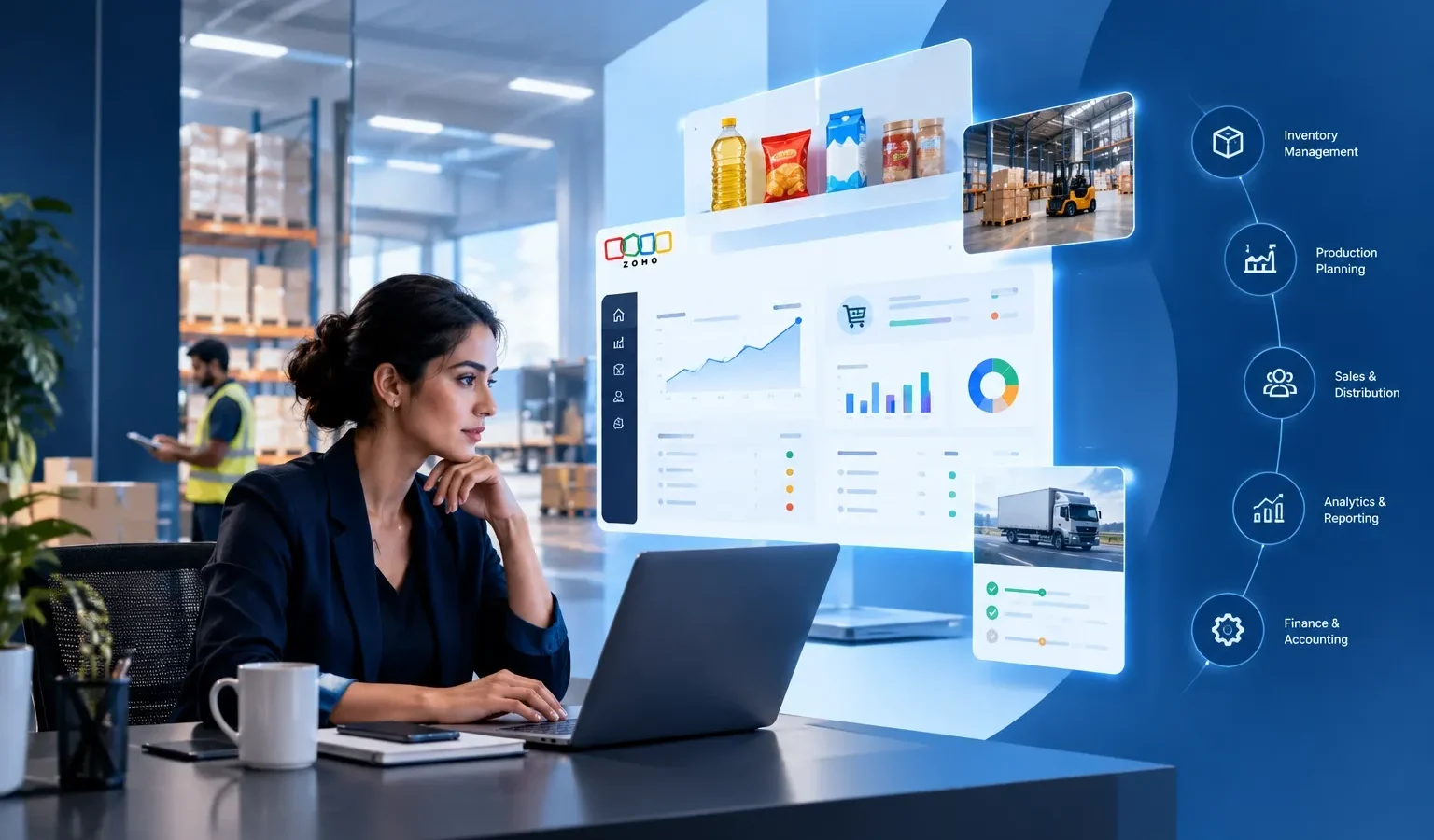
Zoho ERP for FMCG companies in India was just a mash-up of a few Zoho apps. Not anymore. Zoho ERP rolled out as a product in Jan 2026 and now includes batch and expiry tracking, GST invoicing, beat planning, and distributor schemes in one place. So the focus of the real questions is straightforward. Will this Zoho ERP for FMCG match your enterprise, and what does the cost of Zoho ERP for FMCG businesses like yours appear to cost? We’ll discuss both below. And if you want, our Zoho implementation services team is here to discuss your Zoho questions.
What Is Zoho ERP?
Zoho ERP is a standalone cloud ERP from Zoho, launched in January 2026. It is not part of Zoho One.
So is there a single “Zoho ERP” product? Yes, now there is. It covers finance, supply chain, billing, payroll, spend and omnichannel commerce, with ready-made versions for manufacturing, distribution and retail.
Before that, most FMCG teams ran Zoho Inventory, Books, CRM, Analytics and Creator side by side. That setup still works. The difference is that Zoho ERP puts everything on one platform, so there’s less syncing between apps. It’s a young product though, so ask for a demo built around your own workflow before you commit.
Why FMCG Businesses Need an ERP
FMCG runs on thin margins, thousands of SKUs and short shelf lives, so small errors in stock or billing cost real money.
NielsenIQ’s January to March 2026 snapshot put all-India FMCG value growth at 3.0%, with volume growth of just 0.9%. When growth is that slow, you can’t afford leaks. And the leaks are familiar:
- Stockouts in one city while another warehouse sits on extra stock
- Products expiring before they sell
- No clear view of what distributors actually hold
- Billing done by hand, then corrected later
Here’s a quick test. Can you tell, right now, which batch is sitting in which city? If answering takes a few phone calls, that’s the gap an ERP fills.
Key Features of Zoho ERP for FMCG
The features that matter most are batch and expiry control, multi-location stock, GST compliance, beat and scheme management, and reporting.
| Feature | What it does for an FMCG business |
| Batch, serial and expiry tracking | Tracks each lot, flags near-expiry stock, handles damage and write-offs |
| Multi-location inventory | Stock across warehouses, transfers, reorder levels and replenishment rules |
| GST, e-invoicing and e-way bills | Built into billing. E-invoicing applies above ₹5 crore turnover. E-way bills are needed for consignments above ₹50,000 (state rules vary) |
| Beat and field sales | Plan distributor beats and routes, take orders online or offline, bill retailers on the spot |
| Trade schemes | Tiered or product-based schemes, plus a retailer portal to see schemes, invoices and payments |
| Analytics and Zia | Dashboards, demand forecasts and alerts when numbers look off |
Want to track your wider sales pipeline too? Zoho CRM connects to this, and we’ve explained how to build a scalable CRM with Zoho CRM, Creator and Flow in a separate guide.
And when the standard modules don’t cover a workflow, like batch-level production planning or a scheme that only one distributor uses, Zoho’s low-code tools let you build custom manufacturing software on top of the core system.
Benefits of Zoho ERP for FMCG Companies
Less waste, faster billing, better planning and cleaner books.
- Lower expiry loss. Near-expiry alerts and FIFO costing push older stock out first.
- Faster order-to-cash. A field order turns into an invoice and a delivery without anyone retyping it.
- Better demand planning. Sales history by route and SKU feeds your forecasts, so you reorder on data, not gut feel.
- Audit-ready books. Every sale, return and write-off lands in your accounts automatically.
- Room to grow. Pricing is per user, there’s no lock-in contract, and extra locations are added at a fixed monthly rate.
Zoho ERP Business Use Cases in FMCG
Zoho ERP suits manufacturers, distributors and brands that sell through both online and offline channels.
These are typical setups, not client case studies:
- Food and beverage manufacturer. Each production lot is tracked by batch and expiry. If there’s a recall, you find one batch, not a month of dispatches.
- Personal care and household products distributor. Hundreds of retailers and several schemes running at once. Beats, schemes and credit limits sit in one place.
- Multi-city distribution network. Stock moves between warehouses, and head office sees every location live.
- D2C brand with offline retail. Online orders and shop stock share one inventory count, so you stop overselling.
Zoho ERP vs. Other FMCG ERPs
Zoho ERP sits between Tally’s simplicity and SAP Business One’s depth, with distribution tools built in.
| Zoho ERP | Tally | Odoo | SAP Business One | |
| Best fit | SMEs and mid-size FMCG needing finance, stock and field sales together | Accounting-first businesses | Teams with a developer partner | Larger firms with complex processes |
| Beats and schemes | Built in | Usually needs add-ons | Modules or customisation | Usually add-ons or partners |
| Cost and setup | Per-user plans, 14-day trial | Low | Per-user, customisation adds cost | Typically the highest |
| Watch out for | Newer product, fewer public references | Limited sales and stock depth | Setup effort | Cost and timeline |
This is a general comparison. Confirm details with each vendor before you decide.
How to Implement Zoho ERP for an FMCG Business
Map your process, clean your data, pilot in one region, then roll out in phases.
- Map your flow. Ordering, dispatch, returns and schemes, as they work today.
- Clean your data. SKUs, batches, price lists and distributor details.
- Configure. Modules, GST settings, roles and approvals.
- Pilot. Start with one warehouse or one region.
- Train and go live. Phase it, don’t flip everything in one weekend.
Most projects go wrong when data is rushed and training is skipped. Read our list of common Zoho implementation mistakes before you start.
Zoho ERP Cost for FMCG Businesses
Zoho ERP starts at ₹999 per user per month on annual billing, with a minimum of 5 users. Prices exclude GST.
The Zoho ERP cost for an FMCG business depends on a few things:
- Plan. Standard is ₹999 per user per month (annual billing). Premium is ₹2,499.
- Users vs. employees. Staff who only use self-service, like field reps, are priced at ₹249 per employee per month on annual billing.
- Locations. Extra locations cost ₹600 per month each on annual billing.
- Volume. Standard allows 1 lakh transactions a year, Premium 3 lakh.
A quick example: 5 users on Standard come to about ₹60,000 a year before GST. Setup, migration and training are extra. There’s a 14-day free trial and no contract. Prices are from Zoho’s site in October 2026, so check the Zoho ERP pricing page before you budget.
Conclusion
Zoho ERP now brings batch and expiry tracking, GST invoicing, beat planning and distributor schemes into one system. If expiring stock, manual billing and poor distributor visibility are hurting your FMCG business, it’s worth a serious look. Plans start at ₹999 per user per month, with a 14-day free trial and no contract.
It’s a young product, so ask for a demo built around your own workflow before committing. And don’t rush the setup. Clean data and proper training make all the difference.
Not sure if it fits? Book a call with our Zoho consulting team.