

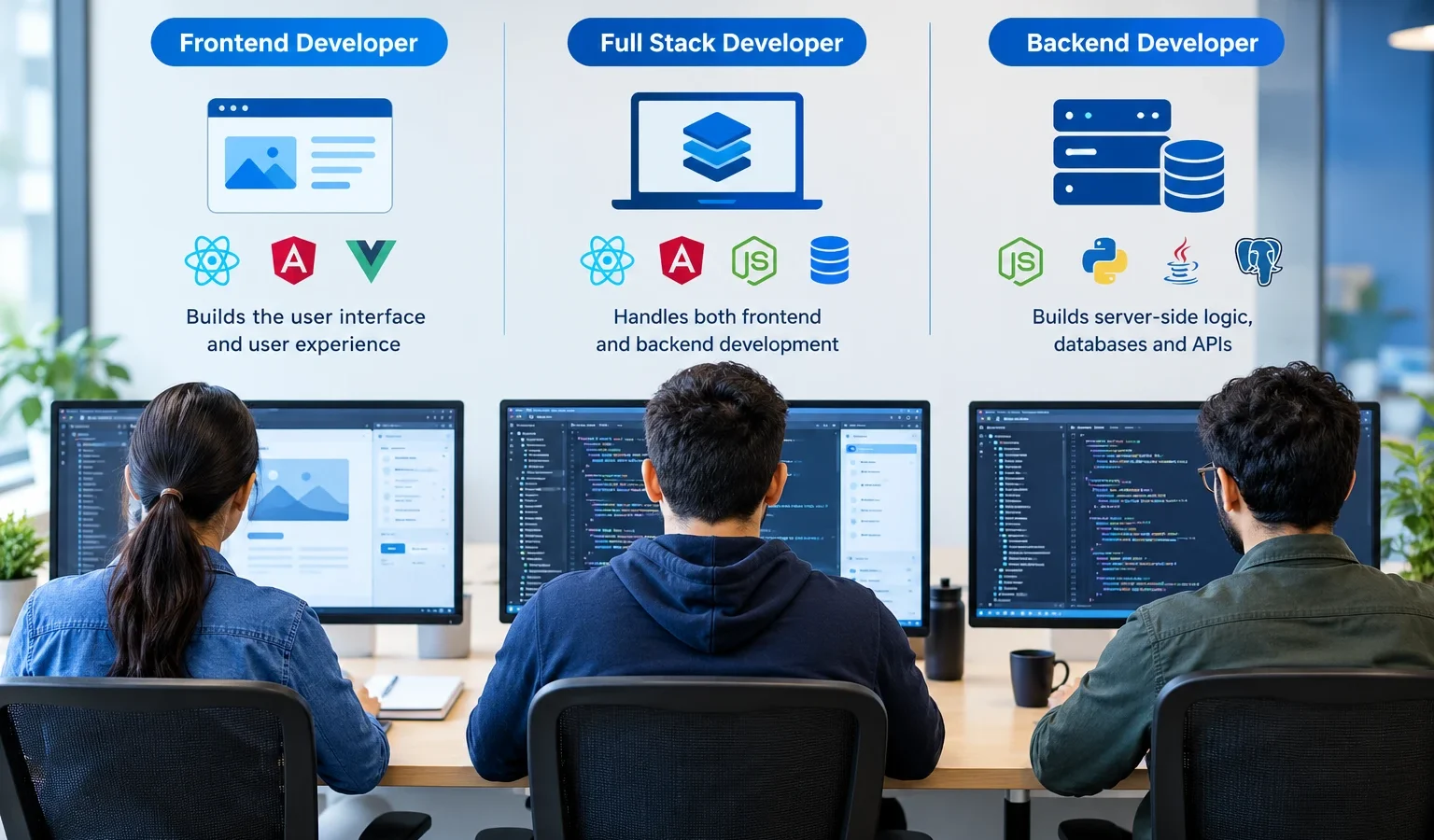
Full stack developer or frontend/backend developers what to pick? Every entrepreneur faces this problem when an idea becomes a product. If you get it wrong, either you’ll be overpaying for people that you do not need at all, or you’ll be asking too much from one single person. The article below will help you to understand the distinction between frontend/backend developers and the place of the full stack developer in this process.
Which Developer Should You Hire?
If you’re building an MVP or watching your budget, hire a full stack developer. If your product already has heavy traffic, complicated screens, or a lot of data work, go for separate frontend and backend developers. Most teams start with one full stack person and bring in specialists as things grow.
What Is a Frontend Developer?
Think of everything you can see and tap on a website or app. Layouts, buttons, forms, menus, even how quickly a page loads. That’s the front-end developer’s job.
Key skills: HTML, CSS, JavaScript, and frameworks like React, Angular, or Vue.
Typical responsibilities:
- Turning designs into screens that actually work
- Making sure the site looks right on every phone and browser
- Keeping pages quick and easy for everyone to use
If the look and feel of your product is what sells it, hire front-end developers who spend all day on exactly this.
What Is a Backend Developer?
The backend is everything your users never see. When someone logs in, pays, or searches for something, the backend checks the details, talks to the database, and sends the answer back. When it works, nobody notices. When it breaks, everybody does.
Key skills: Node.js, Python, Java, PHP, databases, and APIs.
Typical responsibilities:
- Building APIs and designing databases
- Handling security, logins, and payments
- Keeping the server up when traffic suddenly jumps
If your product runs on data or tricky logic, hire back-end developers early. A weak backend is a headache to fix later.
What Is a Full Stack Developer?
So where does a full stack fit in? A full stack developer works on both ends. A common arrangement is React on the front, Node.js on the back and a database on the bottom.
Advantages: because only one person owns a feature from the screen to the database, there are less hand-offs resulting in higher velocities and only one person to bug if something breaks.
Limitations: They know a little about everything but nothing in depth. They’re never quite as good as a specialist on either side and when the product gets large the cracks begin to appear.
Full Stack vs Frontend vs Backend Developer: Comparison Table
| Frontend | Backend | Full Stack | |
| Core skills | HTML, CSS, JavaScript, React | Node.js, Python, databases, APIs | Both sides, moderate depth in each |
| Cost | One specialist salary | One specialist salary | One salary covers both sides |
| Speed | Fast on UI | Fast on logic | Fastest for MVPs |
| Scalability | Strong on UI performance | Strong on system load | Fine early, needs support later |
| Best for | Design-heavy products | Data-heavy products | Startups and first versions |
When Should You Hire a Frontend Developer?
Choose one when the interface is what most users will experience: Ecommerce pages, marketing pages, dashboards. The interface is what everyone will see. Or if the back end is working perfectly but the screens are slow to come up and sluggish to navigate
When Should You Hire a Backend Developer?
Hire one when you are dealing with payments, big data, third-party integrations, or traffic surges. Hire one when ten users love your app, but a thousand hate it.
When Should You Hire a Full Stack Developer?
Use it when you need a working product fast and not a high budget for 2 people. This is perfect for MVPs, internal tools, early SaaS development, where you can hire a full stack developer first, then add specialists later.
Decision Framework: Which One Fits Your Project?
By stage
- MVP: full stack
- Growth: full stack plus a specialist for your weakest side
- Enterprise: separate frontend and backend teams
By budget
- Tight: one full stack developer
- Medium: full stack plus one specialist
- Larger: dedicated frontend and backend developers
By product type
- SaaS: full stack early, backend-heavy as you scale
- eCommerce: strong frontend (speed sells), solid backend for payments and stock
- Mobile app: backend and APIs first, since the app depends on them
- Enterprise software: backend specialists first
Cost Comparison: Hiring Developers in India vs the US/UK
Software Development pay software developers earned median pay of $135,980 a year, based on the US Bureau of Labor Statistics (May 2025 data). Full stack programming opportunities in India, Glassdoor estimates from July 2026 salaries include a full stack salary average of about 6.5 to 7.5 lakh a year, with most salaries listed as between about 4 lakh and 13 lakh a year given city and experience.
One dose of transparency. The figures are salaries, not how much you’d pay if you were to start employing dedicated developers in India through a company. The cost also includes management, equipment, and cost of replacement should someone leave. It’s still far below what the same hire costs in the US or UK, and you get the work done without running your own hiring process.
In-House vs Dedicated Team vs Freelancer
- In-house: Most control, highest cost, slowest to set up.
- Freelancer: Cheapest to start, but availability and accountability can be hit or miss.
- Dedicated team: Full-time developers who work only on your project, without the overhead of employing them. Good middle ground for most startups.
How to Hire the Right Developer in India: Step-by-Step Checklist
- Write down what you’re building and what you can spend.
- Decide full stack, frontend, or backend using the framework above.
- Look at past projects, not just resumes.
- Run a short technical test on a real task, around two to three hours.
- Start with a trial period.
Interview questions worth asking:
- “Walk me through what happens when a user clicks Buy.”
- “How would you fix a slow database query?”
- “Tell me about a bug that took you days to find.”
Red flags:
- Claims to know every language and framework
- Can’t explain their own past projects
- No Git or code review habits
- Refuses a trial or test task
Want more detail on the process? Read our full stack developer India hiring guide.
Why Choose TeamInIndia for Developer Hiring
TeamInIndia enables you to hire developers from India for your projects in full stack, front-end and back-end, whether it is just one developer or the complete team. You define the requirements for the skills, interact with the developers and initiate with an option according to your phase. There is no confusion regarding the roles; it will be sorted for you.
Conclusion
There’s no single right answer to full stack developer vs backend developer vs frontend. It comes down to your stage, your budget, and what your product needs most right now. Start lean with a full stack developer, then add specialists when the work demands it.
Ready to build your team? Hire dedicated developers in India with TeamInIndia and get started this week.