
When you start inquiring about the cost of mobile app development in 2026 to various agencies, one of the biggest frustrations you will probably experience is the different numbers that everyone gives without any reasonable explanation for that discrepancy. For instance, one agency will give you $20 000, another will quote you $150 000 whereas the two of them will argue that their app is going to be exactly the same. That means, how much does it really cost to make an app in 2026, and why is the debate on offshore vs in-house app development coming up time and time again in every.
Actually, the price of the application development is not a static figure, but it is a decision tree. Before you write a single line of code Platform complexity, region, and team structure, each one pulls the cost in a different direction and the biggest difference of all would probably come from whether or not you decide to have an in-house or an outsourcer team for the work of your app.
In this, we are going with what the real prices are for the development of a mobile app in 2026, the difference between offshore and in-house development, and how we assist you to be aware which path will actually make sense for your company, not only your budget.
Mobile App Development Cost in 2026
Let’s start with the numbers, because vague ranges don’t help anyone plan a budget.
A simple MVP with basic functionality , login, a handful of screens, one core feature , typically lands between $15,000 and $50,000 depending on where it’s built. A mid-complexity app with backend integrations, payments, and moderate custom design usually runs $50,000 to $150,000. Enterprise-grade apps with AI features, complex architecture, or regulatory requirements (think fintech or healthcare) can comfortably cross $150,000 and climb past $500,000.
What’s changed in 2026 specifically is the AI layer. Apps increasingly ship with some kind of intelligent feature baked in, and that adds real cost on top of the base build , anywhere from a modest bump for a simple AI API call to a much larger one for a full agentic workflow with multiple tools. If your roadmap includes AI features, it’s worth budgeting for them separately rather than assuming they’re “included” in a standard quote. We’ve actually broken this down in detail in our AI mobile app development cost guide, if you want the specifics.
One more thing worth knowing before you compare quotes: two agencies quoting wildly different numbers for the “same” app almost never mean the same scope. A $40,000 quote and a $120,000 quote usually differ in testing depth, code quality standards, and how senior the people actually writing the code are. Always compare scope documents, not just the headline number.
Factors Affecting Mobile App Development Cost
Several variables decide where your project lands on that price spectrum:
Platform choice
Native iOS or Android development costs more than cross-platform frameworks like Flutter or React Native, which let one codebase serve both platforms.
App complexity
More screens, more integrations, and more custom logic all add hours. A social app with real-time chat costs more than a static content app.
Design requirements
Fully custom UI/UX work costs noticeably more than working off a design system or template.
Backend and infrastructure
Cloud hosting, databases, APIs, and third-party integrations (payment gateways, maps, analytics) all add to the bill, and they’re frequently underestimated by first-time founders.
Team location
This is the single biggest cost lever, and it’s the whole subject of the next section.
Compliance needs
Regulated industries like healthcare or finance often add 30–80% to the base cost because of the extra security, testing, and audit work involved.
Post-launch maintenance
Budgeting stops at launch for a lot of founders, but ongoing support typically runs 15–20% of the original build cost every year.
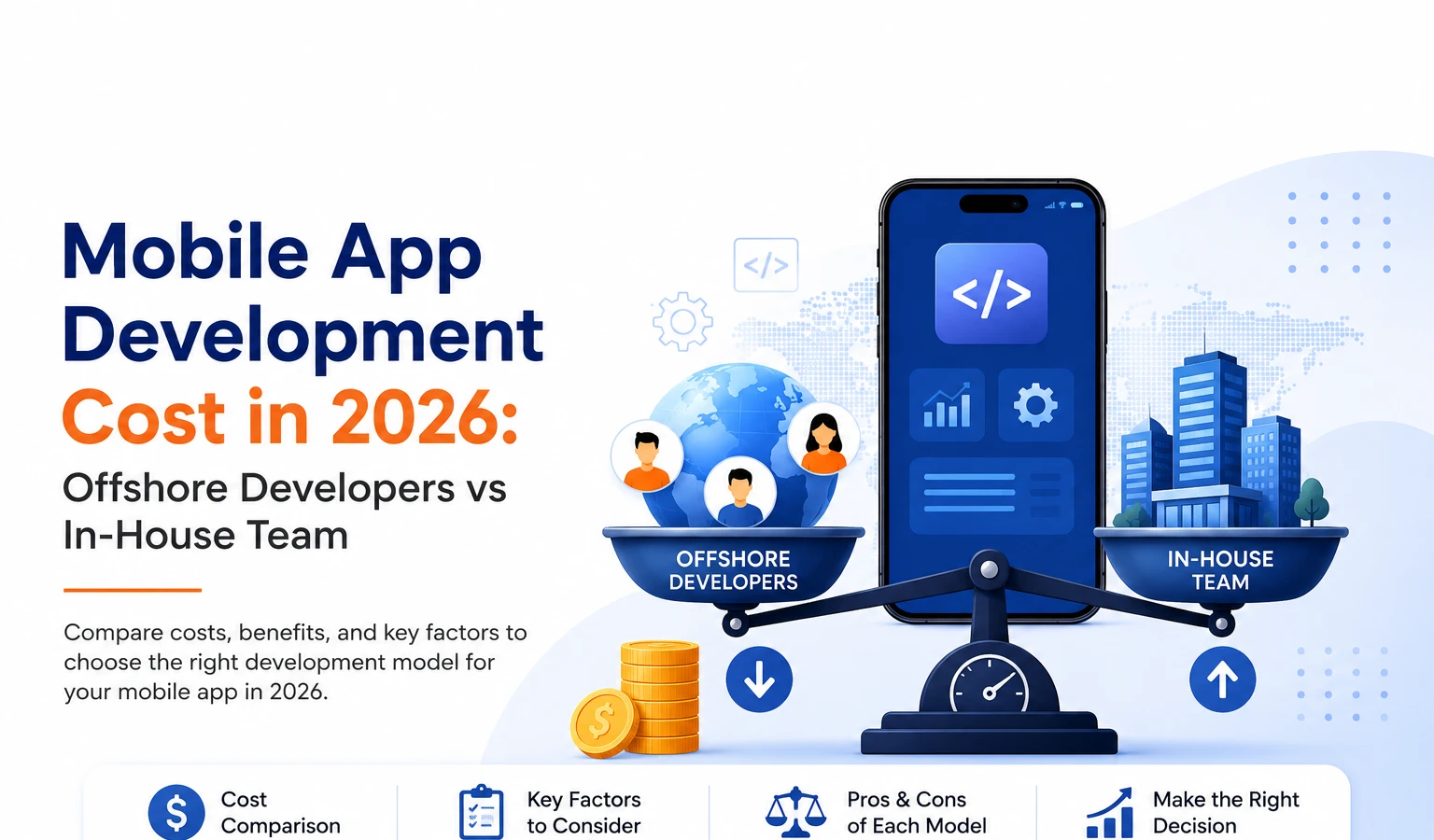
Offshore Developers vs In-House Team: Cost Comparison
Here’s where the real decision happens. The table below lays out how the two models typically compare in 2026.
| Factor | Offshore Developers | In-House Team |
| Hourly rate | Roughly $18–$75/hr depending on region (South Asia tends to sit at the lower end, Eastern Europe and Latin America a bit higher) | $100–$250/hr equivalent once salary, benefits, and overhead are factored in |
| Annual cost per senior developer | Roughly $42,000–$68,000 fully loaded | Often $250,000+ fully loaded in the US |
| Hiring timeline | Days to a few weeks | Typically 3–6 months including recruiting |
| Team scaling | Flexible , scale up or down per project phase | Slower and costlier to resize |
| Management overhead | Higher , async communication, time zone gaps, more documentation needed | Lower , same-room or same-timezone collaboration |
| Best suited for | MVPs, well-scoped projects, startups managing a tight budget | Long-term products needing constant iteration, tight IP control, or regulated builds |
| Realistic net savings | 20–40% once management overhead is priced in (not the 50–70% headline number) | N/A , this is the baseline cost |
Notice that last row. The headline hourly-rate gap between offshore and in-house looks huge on paper, but once you factor in the extra product management time that async, cross-timezone work demands, the real savings settle into a more modest , but still meaningful , 20-40% range for most companies.
Benefits of Hiring Offshore App Developers
The cost savings are the obvious draw, but they’re not the only reason offshore has become the default choice for so many startups and growing businesses:
Lower burn rate
More runway for the same budget, especially valuable for bootstrapped or early-stage companies.
Access to specialized talent
Countries like India have deep pools of developers experienced in specific frameworks, AI integrations, and niche platforms that can be harder to find locally.
Faster ramp-up
No lengthy hiring cycle. A vetted team can often start within days.
Flexible scaling
Add specialists for a specific sprint, then scale back down without severance or long-term commitments.
Round-the-clock development
With the right handoff process, work can effectively continue across time zones instead of stopping at 6pm.
If this route appeals to you, it’s worth looking directly at how to hire mobile app developers the right way , vetting for real shipped work, not just resume keywords.
Benefits of Building an In-House Team
In-house isn’t obsolete just because offshore is cheaper , it solves different problems:
Tighter communication
Same time zone, often same room, means faster decisions and fewer misunderstandings.
Stronger IP control
Sensitive, proprietary, or heavily regulated products often need everyone under one roof, or at least one contract.
Deeper product ownership
In-house engineers tend to stick around, building institutional knowledge about your product over years, not just sprints.
Easier compliance
For fintech, healthcare, or government-adjacent apps, in-house teams simplify audits and security sign-offs considerably.
The trade-off is straightforward: you pay a lot more for that proximity and control.
Which Option Is Better for Your Business in 2026?
There isn’t a universal right answer here , it depends on what you’re building and where you are as a company.
Choose offshore if you’re a startup or SME watching runway closely, need to launch an MVP fast, or don’t have complex compliance requirements weighing on the project.
Choose in-house if you’re building something highly regulated, need airtight IP protection, or you’re past MVP stage and need a product team that lives and breathes your roadmap every single day.
Many businesses in 2026 are actually landing on a hybrid model , a lean in-house product lead paired with an offshore development team handling the build. It captures a good chunk of the cost savings while keeping decision-making close to home.
Why Choose TeamInIndia for Mobile App Development?
This is exactly the gap TeamInIndia is built to close. Instead of a generic dev-for-hire arrangement, you get vetted, experienced developers who work as an extension of your product team , with clear communication processes, transparent pricing, and technical depth across native and cross-platform frameworks. Whether you need a single developer or a full pod covering design, QA, and backend, our mobile app development services are built around the way modern product teams actually work in 2026, not the outdated “ticket and wait” outsourcing model.
Conclusion
There’s no single figure that answers “how much does it cost to build a mobile app” , it depends on complexity, platform, compliance needs, and above all, who’s building it. Offshore development remains the more budget-friendly route for most startups and growing businesses in 2026, while in-house teams still make sense for regulated, IP-sensitive, or deeply iterative products. The smartest move is to get honest about your actual constraints , budget, timeline, and control , before picking a model, rather than chasing the lowest hourly rate on a landing page.