

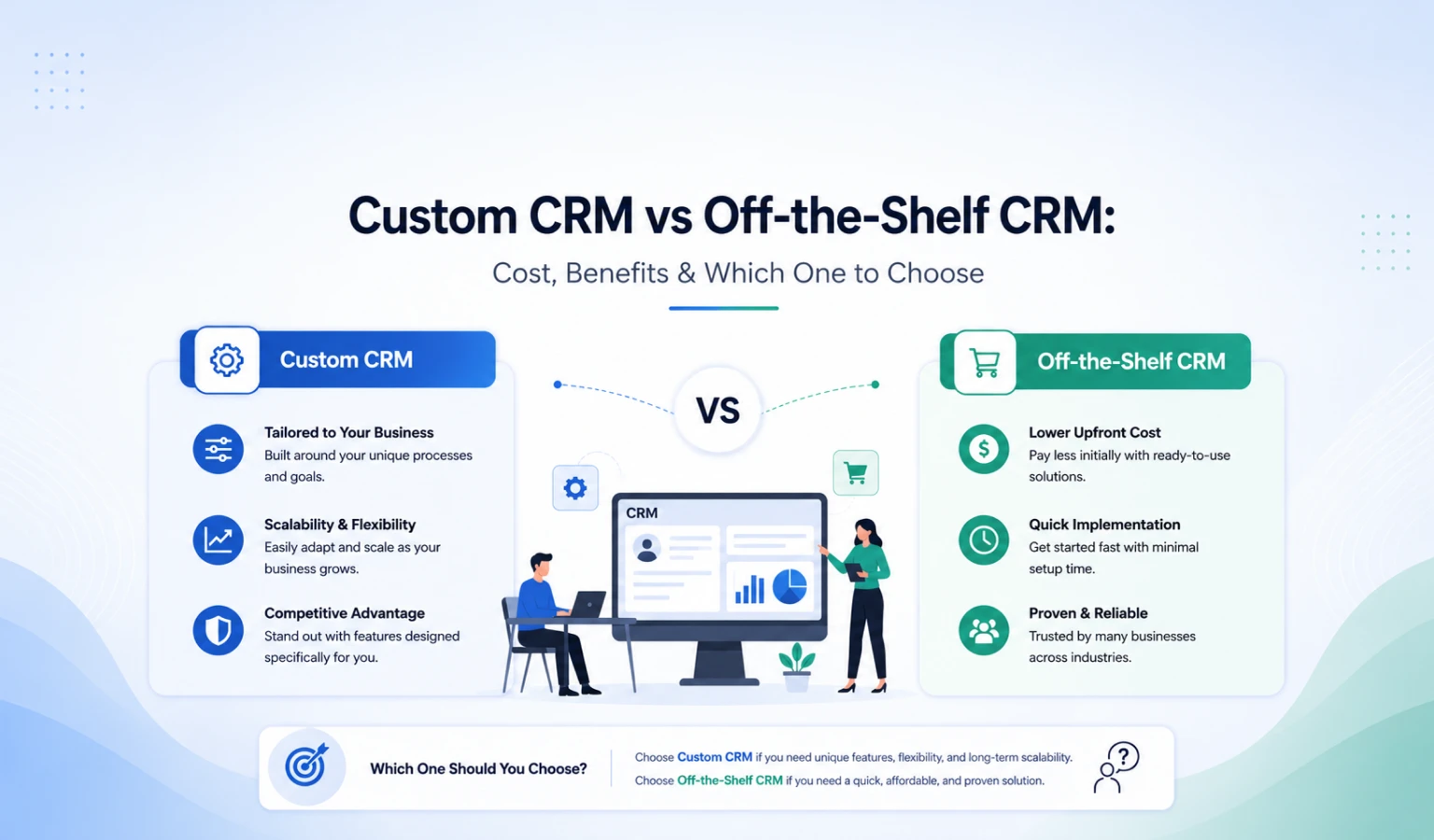
Every growing business eventually hits the same wall: spreadsheets and sticky notes stop working, and sales, support, and marketing teams need one shared system to track customers. That’s when the real question shows up ,do you buy ready-made CRM software, or invest in Custom CRM Software built around the way your team actually works?
Choosing between Custom CRM vs Off-the-Shelf CRM: Which is Better for Your Business? depends less on which tool is “better” in general and more on your stage, budget, and how unique your workflows really are. This guide breaks the decision down across cost, features, scalability, and security, so you can decide based on facts, not sales pitches.
What is a Custom CRM?
A custom CRM is a system built specifically for your business ,its sales process, its data structure, its reporting needs. Instead of adapting your workflow to fit a generic tool, a Custom CRM Development project starts with how your team actually sells, supports, and retains customers, then builds the software around it.
This work is usually handled by a dedicated CRM Development Company, through discovery, design, and iterative development ,not a one-size-fits-all install.
What is an Off-the-Shelf CRM?
An off-the-shelf CRM usually refers to an already developed and pre-configure platform which one subscribes to and then customizes. For instance, one may think of popular CRM systems like Salesforce, HubSpot, or Zoho as off-the-shelf CRM systems. Features of these CRMs include standard sales, marketing, and support tools, and a marketplace of extensions and integrations where users can choose from the offerings. Setup time is minimal; you create your profile, design fields and pipelines, invite colleagues, and within a week, everyone can start using the application.
Other enterprises decide to take the HubSpot CRM implementation a notch higher; Zoho CRM customization, or they opt for consulting a couple of Salesforce professional developers to further fine tune the system and make it reflect their specific workflows without having to develop it from zero in-house.
Key Differences Between Custom CRM and Off-the-Shelf CRM
| Factor | Custom CRM | Off-the-Shelf CRM |
| Customization | Built exactly to your workflow | Limited to platform’s configuration options |
| Ownership | You own the code and data model | Vendor controls the platform |
| Time to launch | Weeks to months | Days to weeks |
| Licensing | One-time build, no per-user fees | Recurring per-user subscription |
| Scalability | Scales however your business needs | Scales within the vendor’s plan tiers |
| Integrations | Native, purpose-built | Depends on available connectors/APIs |
| Long-term cost | Higher upfront, lower over time | Lower upfront, compounds with users |
Cost Comparison
Pricing depends heavily on scope and team size, but here’s what the numbers actually look like as of July 2026.
Off-the-Shelf CRM: Subscription Pricing (per user/month)
| Platform | Entry Tier | Mid Tier | Top Tier |
| Zoho | Free (up to 3 users) / $14 (Standard) | $23 (Professional) | $40–$52 (Enterprise/Ultimate) |
| HubSpot | Free / $20 (Starter) | ~$90 (Professional) | $150 (Enterprise) |
| Salesforce | $25 (Starter Suite) | $100–$175 (Pro Suite/Enterprise) | $350–$550 (Unlimited/Agentforce 1) |
These are list prices per seat, and none of them are the full story. HubSpot adds a mandatory onboarding fee of roughly $1,500–$7,000 on Professional and Enterprise plans. Zoho implementation typically runs $3,000–$50,000+ depending on team size and data migration. Salesforce implementations range even wider ,usually $10,000–$150,000+ for small and mid-market rollouts, climbing past $150,000–$500,000+ for enterprise, multi-cloud deployments.
What that means for a 25-person sales team, in annual license cost alone:
| Platform/Tier | Annual Cost (25 users) |
| Zoho Professional | $6,900/year |
| HubSpot Professional | $27,000/year |
| Salesforce Enterprise | $52,500/year |
Custom CRM: Development Cost (2026)
| Build Tier | Development Cost | Timeline | Ongoing Maintenance |
| MVP / Basic | $15,000–$40,000 | 2–4 months | 15–25% of build cost/year |
| Mid-range | $50,000–$150,000 | 4–9 months | 15–25% of build cost/year |
| Enterprise-grade | $150,000–$300,000+ | 9–12+ months | 15–25% of build cost/year |
The break-even math
This is where the decision gets concrete. A 25-person team on Salesforce Enterprise pays roughly $52,500 a year in licenses alone ,about $157,500 over three years, before implementation or add-ons are even counted. That’s already inside the price range of a mid-to-large Custom CRM Development project, which then carries no recurring per-seat fee at all.
On the other end, that same team on Zoho Professional pays under $7,000 a year, so a custom build wouldn’t pay for itself for well over a decade. The real break-even point isn’t about company size alone ,it’s about which platform tier your workflows actually force you onto, and how fast your headcount is growing.
Pricing reflects publicly listed rates as of July 2026. Vendors update pricing frequently, so confirm current rates directly with each provider, or with a CRM Development Company like Team In India, before budgeting.
Benefits of Custom CRM
- Built around your exact sales and service process, not the other way around
- No recurring per-user licensing fees that grow with headcount
- Full ownership of code, data, and future roadmap
- Easier to integrate with legacy or proprietary internal systems
- A genuine competitive edge ,competitors can’t buy the same system
- Backed by focused CRM Software Development rather than generic configuration
Benefits of Off-the-Shelf CRM
- Fast deployment ,live in days, not months
- Lower upfront cost, easier to budget and approve
- Regular vendor-driven updates, security patches, and new features
- Large talent pool already trained on tools like Salesforce, HubSpot, and Zoho
- Established app marketplaces for common integrations
- Proven, battle-tested reliability at scale
Which CRM is Best for Small Businesses?
For most small businesses and early-stage startups, an off-the-shelf CRM is the practical starting point. The upfront cost is low, setup is fast, and platforms like Zoho or HubSpot cover the basics ,contact management, pipelines, email tracking ,without a development cycle. Light Zoho CRM customization or HubSpot CRM implementation usually closes any remaining gap.
Which CRM is Best for Growing Enterprises?
As companies scale, workflows get more specific, data volumes grow, and off-the-shelf platforms start to feel restrictive ,locked feature tiers, rising per-user costs, integrations that only go so deep. This is where Custom CRM Software earns its cost. Enterprises with unique processes, strict compliance needs, or legacy systems to connect often choose to hire Custom CRM developers and build a system that fits the business, instead of forcing the business to fit the system.
Factors to Consider Before Choosing
- Budget: Can you absorb a larger upfront cost, or do you need a low, predictable monthly spend?
- Process complexity: Is your sales/service workflow standard, or genuinely unique?
- Growth trajectory: Will you add users and modules rapidly over the next few years?
- Integration needs: Do you rely on legacy or proprietary systems?
- Data security & compliance: Do you need full control over where and how data is stored?
- Timeline: Do you need to launch in days, or can you invest months in a build?
- In-house IT support: Do you have the team to maintain a custom system long-term?
Conclusion
There’s no universal winner in the Custom CRM vs Off-the-Shelf CRM debate ,only what’s right for your business today and where it’s headed. Off-the-shelf platforms win on speed and low upfront cost. Custom CRM wins on fit, ownership, and long-term economics at scale. Many businesses land somewhere in between, starting with a configured platform and moving to Custom CRM Development Services once their processes outgrow it. Team In India works across both paths ,from Salesforce and HubSpot implementations to fully Custom CRM Development ,so you can build the system your business actually needs, not the one you’re stuck adapting to.
FAQs
Is it better than ready-made software?
It is a matter of the company’s size, business processes, and goals. Custom CRM is definitely a way to make your business more flexible but at the expense of slower launch time whereas the off-the-shelf solution offers a much quicker implementation.
Do you know how much it costs to develop custom CRM software?
It can be anything if there are too many features integrations number of users, and also the development complexity.
Who should be considering customizing their CRM?
Those companies that have unusual processes, lots of departments, or industry-specific rules and regulations can reap maximum benefits.
What are the main drawbacks of a readymade CRM?
Restricted customization, subscription renewals, dependency on the service provider and a bunch of useless features.
Can it link a custom CRM to other softwares?
Of course, a custom-built CRM will work as a hub and will be able to link with various types of third-party softwares including ERP, payment gateways HRMS marketing software, and accounting software to name a few.
Differences in safety measures between custom and standard CRM platforms?
Custom CRM can, in a way, have a higher level of security since you can manage policies, decide on permissions, and control how to store your data.
Should one go in for custom CRM as it will be an investment?
If a company intends on growing its business on a long-term basis and calls for that its business processes are fully optimized then in most cases, they will actually experience that a custom CRM is a good investment and brings more returns over time, In particular since such a CRM is tailor-made to fit their needs.


